本期目录

2024年, 第35卷, 第04期 刊出日期:2024-04-22
  

  • 全选
    |
    Editorial
  • Shu Lin, Kezhen Qi
    中国化学快报. 2024, 35(04): 109431. https://doi.org/10.1016/j.cclet.2023.109431
    摘要 ( ) PDF全文 ( ) HTML 可视化 收藏
  • 评论
  • Sajid Mahmood, Haiyan Wang, Fang Chen, Yijun Zhong, Yong Hu
    中国化学快报. 2024, 35(04): 108550. https://doi.org/10.1016/j.cclet.2023.108550
    摘要 ( ) PDF全文 ( ) HTML 可视化 收藏
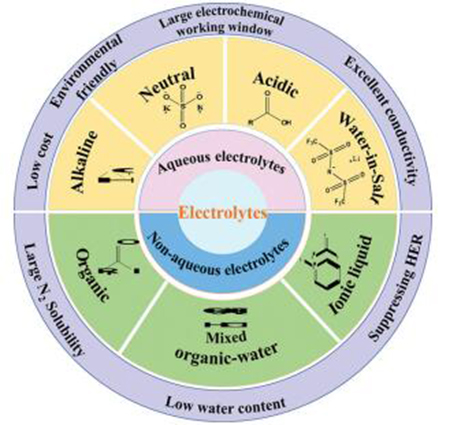
    Electrochemical nitrogen reduction reaction (ENRR) provides a promising strategy to achieve sustainable synthesis of ammonia. However, despite great efforts devoted to this research field, the problems such as low energy efficiency and weak selectivity still impede its practical implementation. Most of the research to date has been concentrated on creating sophisticated electrocatalysts, and adequate knowledge of electrolytes is still lacking. Herein, the recent progress in electrolytes for ENRR, including alkaline, neutral, acidic, water-in-salt, organic, ionic liquid, and mixed water-organic electrolytes, is thoroughly reviewed to obtain an in-depth understanding of their effects on electrocatalytic performance. Recently developed representative electrocatalysts in various types of electrolytes are also introduced, and future research priorities of different electrolytes are proposed to develop new and efficient ENRR systems.
  • Li Li, Fanpeng Chen, Bohang Zhao, Yifu Yu
    中国化学快报. 2024, 35(04): 109240. https://doi.org/10.1016/j.cclet.2023.109240
    摘要 ( ) PDF全文 ( ) HTML 可视化 收藏
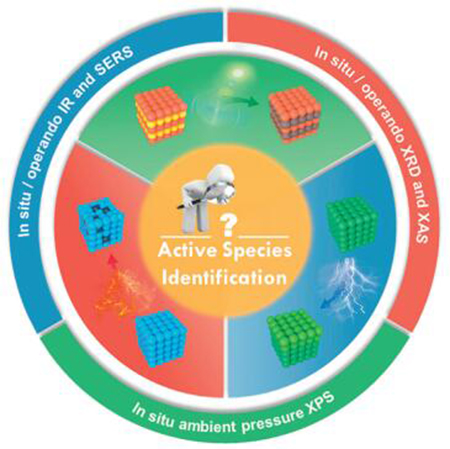
    Converting CO2 into value-added chemicals and fuels through various catalytic methods to lower the atmospheric CO2 concentration has been developed to be a crucial means to alleviate the energy shortage and ameliorate the ever-fragile environment status. However, the complexity of the CO2 conversion reaction and the strong reduction conditions lead to the inevitable structural evolution, making it difficult for the prior design of suitable catalytic materials. Herein, to guide the rational design of efficient catalysts, we will be centered on the thermal, electro, and photo-induced structural evolution and active species identification during the CO2 conversion, including the in situ/operando characterization techniques monitoring the activation, steady, and deactivation stage of the catalysts as well as the inherent restructuring mechanism towards active species. Besides, the future challenges and opportunities on the merits of combining the structural evolution with the adsorbed intermediates recognized by ultra-fast spectroscopic techniques, simultaneously, the combination of theoretical simulation and the results of in situ experiments will also be addressed. This review can not only guide the identification of real active species, but also provide an approach to design the specific active species towards CO2 conversion, rather than only focusing on activity, for the purpose of practical industrial application.
  • Zhaoru Chen, Xiaoxu Liu, Haonan Chen, Jialong Li, Xiaofeng Wang, Jianfeng Zhu
    中国化学快报. 2024, 35(04): 109194. https://doi.org/10.1016/j.cclet.2023.109194
    摘要 ( ) PDF全文 ( ) HTML 可视化 收藏
    Cultural relics have their unique artistic, cultural and historical value, and the protection of important cultural relics is conducive to the inheritance of historical culture. As a kind of cementing agent and binder commonly seen in cultural relics protection, epoxy resin is widely used in the bonding and consolidation of various materials in cultural relics, which has important practical application value. In this review, a systematic classification of commonly used epoxy resins, including their molecular structures, synthesis reactions and properties are provided, the problems and solutions of epoxy resin in cultural relics protection are summarized. The solutions are classified into three aspects: functional epoxy resin, blending modification, and other modification. Representative application examples of epoxy resin are listed in the field of cultural relics protection, and the development direction of epoxy resin in cultural relics protection in the future is proposed, which provides useful guidance for the modification of epoxy resin and its application in cultural relics protection in the future.
  • Yunfa Dong, Shijie Zhong, Yuhui He, Zhezhi Liu, Shengyu Zhou, Qun Li, Yashuai Pang, Haodong Xie, Yuanpeng Ji, Yuanpeng Liu, Jiecai Han, Weidong He
    中国化学快报. 2024, 35(04): 109261. https://doi.org/10.1016/j.cclet.2023.109261
    摘要 ( ) PDF全文 ( ) HTML 可视化 收藏
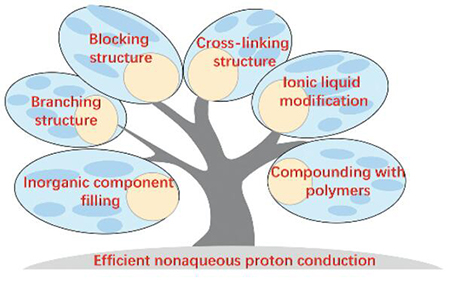
    High-temperature proton exchange membranes (HT-PEMs) possess excellent thermal and outstanding electrochemical stability, providing an avenue to realize high-temperature proton exchange membranes fuel cells (HT-PEMFCs) with both superior power density and long-term durability. Unfortunately, polybenzimidazole (PBI), a typical material for conventional HT-PEMs, fails to compromise the high nonaqueous proton conductivity and high mechanical properties, thus hindering their practical applications. Achieving efficient nonaqueous proton conduction is crucial for HT-PEMFC, and many insightful research works have been done in this area. However, there still lacks a report that integrates the host-guest interactions of phosphoric acid doping and the structural stability of polymers to systematically illustrate modification strategies. Here, we summarize recent advancements in enhancing the nonaqueous proton conduction of HT-PEMs. Various polymer structure modification strategies, including main chain and side group modification, cross-linking, blocking, and branching, are reviewed. Composite approaches of polymer, including compounding with organic porous polymers, filling the inorganic components and modifying with ionic liquids, etc., are also covered in this work. These strategies endow the HT-PEMs with more free volume, nanophase-separated structure, and multi-stage proton transfer channels, which can facilitate the proton transportation and improve their performance. Finally, current challenges and future directions for further enhancements are also outlined.
  • Shuaiwen Li, Zihui Chen, Feng Yang, Wanqing Yue
    中国化学快报. 2024, 35(04): 108793. https://doi.org/10.1016/j.cclet.2023.108793
    摘要 ( ) PDF全文 ( ) HTML 可视化 收藏
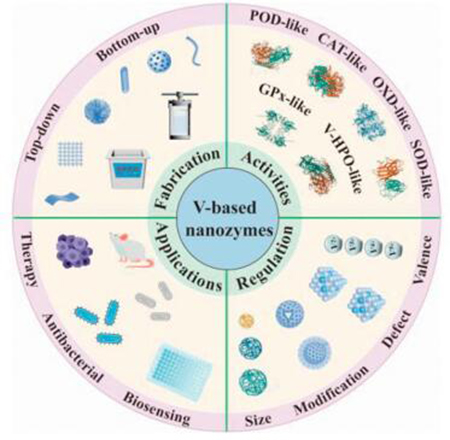
    Nanomaterials with enzyme-mimic (nanozyme) activity have garnered considerable attention as a potential alternative to natural enzymes, thanks to their low preparation cost, high activity, ease of preservation, and unique physicochemical properties. Vanadium (V) is a transition metal that integrates the benefits of valence-richness, low cost, and non-toxicity, making it a desirable candidate for developing a range of emerging nanozymes. In this review, we provide the first systematic summary of recent research progress on V-based nanozymes. First, we summarize the preparation of V-based nanozymes using both top-down and bottom-up synthesis methods. Next, we review the mechanism of V-based nanozymes that mimic the activity of various enzymes. We then discuss methods for regulating V-based nanozyme activity, including morphology, size, valence engineering, defect engineering, external triggering, and surface engineering. Afterward, we outline various biomedical applications, including therapeutic, anti-inflammatory, antibacterial, and biosensing. Finally, we prospect the challenges and countermeasures for V-based nanozymes based on their development. By summarizing recent research progress on V-based nanozymes, we hope to provide useful insights for researchers to further explore their potential applications and overcome their existing challenges.
  • Yuqing Zhu, Haohao Chen, Li Wang, Liqun Ye, Houle Zhou, Qintian Peng, Huaiyong Zhu, Yingping Huang
    中国化学快报. 2024, 35(04): 108884. https://doi.org/10.1016/j.cclet.2023.108884
    摘要 ( ) PDF全文 ( ) HTML 可视化 收藏
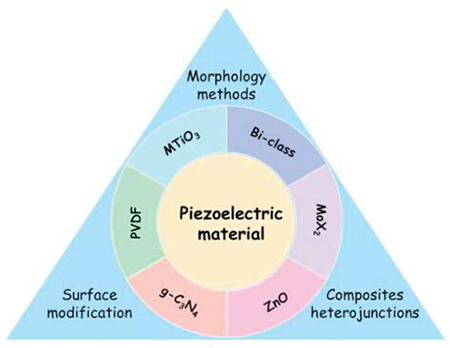
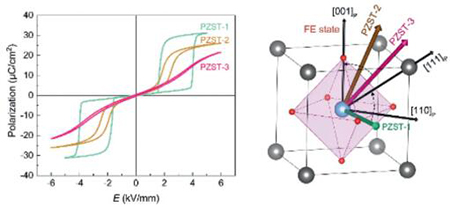
    Piezoelectric catalysis, a new catalytic method, is widely used in the field of environmental sanitation, including waste water treatment and dye degradation. However, in the face of the growing environmental pollution problem, the efficiency of piezoelectric catalysis is still hampered by the stress variation in the natural environment. Therefore, it is particularly important to improve the catalytic efficiency of piezoelectric materials. We divide piezoelectric materials into two categories: inorganic piezoelectric materials and organic piezoelectric materials. Then the mainstream inorganic piezoelectric materials are divided into four subcategories, namely: (1) MTiO3 (M = Ba, Sr), (2) bi-class catalytic materials, (3) MoX2 (X = S, Se), and (4) ZnO piezoelectric materials. The mainstream organic piezoelectric materials are divided into PVDF and g-C3N4 materials. At the same time, the above materials are summarized to explain the excellent performance of materials from the perspective of structure and piezoelectric principle. In addition, we summarized the modification methods that can be applied to piezoelectric materials: (1) Morphology methods, (2) composites with heterojunctions, and (3) surface modification. Finally, we summarized the prospects of piezoelectric materials in the field of environment and water treatment.
  • Guiyang Zheng, Xuelian Kang, Haoran Ye, Wei Fan, Christian Sonne, Su Shiung Lam, Rock Keey Liew, Changlei Xia, Yang Shi, Shengbo Ge
    中国化学快报. 2024, 35(04): 108817. https://doi.org/10.1016/j.cclet.2023.108817
    摘要 ( ) PDF全文 ( ) HTML 可视化 收藏
    Humans have relied on biomass for survival and development since the Stone Age. All aspects of human needs for materials are covered by tools, fuel, and buildings. Nowadays, metals and petroleum-based materials are widely used in highly developed industries. Unfortunately, environmental contamination and the loss of natural resources have led to the reemergence of biomass resources as efficient and sustainable energy sources. Notably, simple and direct applications can no longer meet the demand for functionalization, high performance of materials and construction materials. Therefore, it is imperative to modify biomass and combine its utilisation to produce functionalization and high performance materials. For example, construction materials with superior mechanical properties and water resistance can be produced by reinforcing fibres to facilitate crosslinking. Water-oil separation or adsorption effects of hydrogels and aerogels are determined by the porosity and lightness of biomass, biocomposite conductor is prepared by chimaeric conductive material. Here, we review the approaches that have been taken to devise an environmentally friendly yet fully recyclable and sustainable functionalised biocomposites from biomass and its potential directions for future research.
  • Meihui Liu, Xinyuan Zhou, Xiao Li, Zhenjie Xue, Tie Wang
    中国化学快报. 2024, 35(04): 108875. https://doi.org/10.1016/j.cclet.2023.108875
    摘要 ( ) PDF全文 ( ) HTML 可视化 收藏
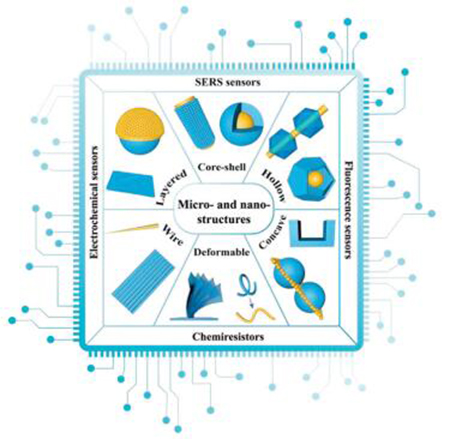
    Changes in trace substances in human metabolites, which are related to disease processes and health status, can serve as chemical markers for disease diagnosis and symptom monitoring. Real-time online detection is an inevitable trend for the future of health monitoring, and the construction of chips for detection faces major challenges. The response of sensors often fails to meet the requirements for chip-based detection of trace substances due to the low efficiency of interfacial heterogeneous reactions, necessitating a rational design approach for micro- and nano-structures to improve sensor performance with respect to sensitivity and detection limits. This review focuses on the influence of micro- and nano-structures that used in chip on sensing. Firstly, this review categorizes sensors into chemiresistors, electrochemical sensors, fluorescence sensors, and surface enhanced Raman scattering (SERS) sensors based on their sensing principle, which have significant applications in disease diagnosis. Subsequently, commencing from the application requirements in the field of sensing, this review focuses on the different structures of nanoparticle (NP) assemblies, including wire, layered, core-shell, hollow, concave and deformable structures. These structures change in the size, shape, and morphology of conventional structures to achieve characteristics such as ordered alignment, high specific surface area, space limitation, vertical diffusion, and swaying behavior with fluid, thereby addressing issues such as poor signal transmission efficiency, inadequate adsorption and capture capacity, and slow mass transfer speed during sensing. Finally, the design direction of micro- and nano-structures, and possible obstacles and solutions to promote chip-based detection have been discussed. It is hope that this article will inspire the exploration of interface micro- and nano-structures modulated sensing methods.
  • Tao Yu, Vadim A. Soloshonok, Zhekai Xiao, Hong Liu, Jiang Wang
    中国化学快报. 2024, 35(04): 108901. https://doi.org/10.1016/j.cclet.2023.108901
    摘要 ( ) PDF全文 ( ) HTML 可视化 收藏
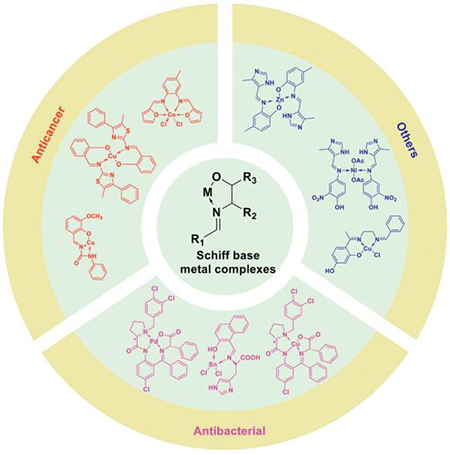
    Schiff base metal complexes are of great importance in pharmaceutical science owing to their unique chemical properties, which enable them to exhibit diverse biological activities such as anti-bacterial, anti-oxidant, anti-inflammatory, and anti-tumor properties. Furthermore, Schiff base metal complexes can serve as reagents and catalysts in chemical reactions. This review aims to provide an overview of our recently published studies on Cu(II) and Pd(II) complexes derived from proline Schiff base ligands. We also discuss the potential applications of these metal complexes in the fields of antibacterial and chiral resolution.
  • Wei Zhou, Xi Chen, Lin Lu, Xian-Rong Song, Mu-Jia Luo, Qiang Xiao
    中国化学快报. 2024, 35(04): 108902. https://doi.org/10.1016/j.cclet.2023.108902
    摘要 ( ) PDF全文 ( ) HTML 可视化 收藏
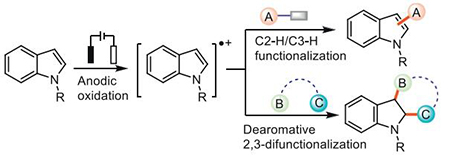
    Indole-derived radical cations, open-shell reactive species, display distinctive dual reactivity due to the carbon-centered radical and more electrophilic carbocation, which frequently appear in a variety of single electron oxidation reactions for synthesizing structurally diverse functionalized indoles and indolines. Electrocatalysis is considered as a synthetically attractive and environmentally friendly alternative for driving the single electron oxidation of indoles. Remarkable achievements in electrocatalytic indole-derived radical cation-mediated indole functionalization have been realized so far. This review comprehensively summarizes the recent progresses in the applications of electrocatalytic indole radical cations, including C(sp2)-H functionalization, dearomative 2,3-difunctionalization, and ring-opening reaction, emphasizing the vital single electron oxidation steps of indoles, the substrates scope and limitations, and the reaction mechanisms.
  • Cheng-Da Zhao, Huan Yao, Shi-Yao Li, Fangfang Du, Li-Li Wang, Liu-Pan Yang
    中国化学快报. 2024, 35(04): 108879. https://doi.org/10.1016/j.cclet.2023.108879
    摘要 ( ) PDF全文 ( ) HTML 可视化 收藏
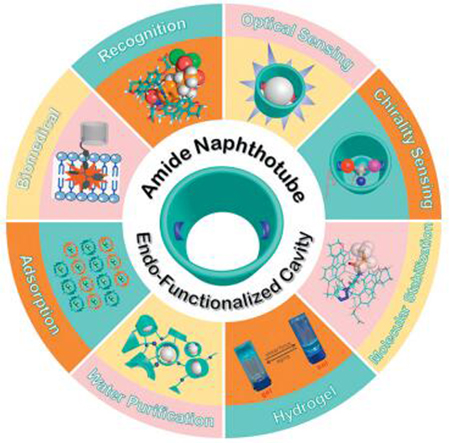
    Selective molecular recognition in water is routine for bioreceptors, but remains challenging for synthetic hosts. This is principally because noncovalent interactions are usually less efficient in aqueous environments. By mimicking the cavity feature of bioreceptors, Prof. Wei Jiang proposed and clarified the concept of “endo-functionalized cavity”. Through situating polar binding sites into a deep hydrophobic cavity, we designed and synthesized several macrocyclic hosts, among which amide naphthotubes are the most representative. The hosts can selectively recognize various polar molecules including organic micropollutants, drug molecules, and chiral molecules in water by employing the hydrophobic effect and shielded hydrogen bonding. In addition, these biomimetic hosts have been applied in spectroscopic analysis, adsorptive separation and self-assembly. In this review, we provide an overview of recent advances on amide naphthotubes with special emphasis on the efforts of Jiang's group. We are convinced that these biomimetic macrocycles will make further contributions to supramolecular chemistry and beyond.
  • Conghui Wang, Lei Xu, Zhenhua Jia, Teck-Peng Loh
    中国化学快报. 2024, 35(04): 109075. https://doi.org/10.1016/j.cclet.2023.109075
    摘要 ( ) PDF全文 ( ) HTML 可视化 收藏
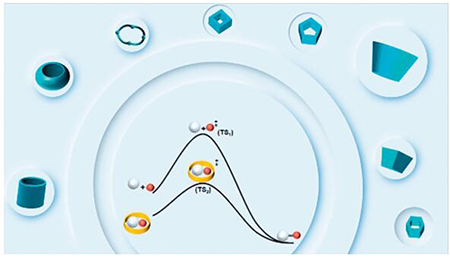
    Numerous supramolecular macrocycles have been utilized for developing catalysts by exploiting their specific molecular recognition and ability to form inclusion complexes through noncovalent interactions. The cyclic structure and modified functional groups of these macrocycles can influence substrate and transition state stability, as well as reaction selectivity. The inner cavities of these macrocycles are particularly beneficial, as they enable substrates to adopt preorganized arrangements and serve as versatile platforms for highly efficient supramolecular catalytic systems. This minireview provides an overview of recent advancements in supramolecular catalysis using various macrocycles, such as crown ethers, cyclodextrins, calixarenes, pillararenes, cucurbiturils, and other novel macrocycles.
  • 通信
  • Lang Gao, Cen Zhou, Rui Wang, Feng Lan, Bohang An, Xiaozhou Huang, Xiao Zhang
    中国化学快报. 2024, 35(04): 108832. https://doi.org/10.1016/j.cclet.2023.108832
    摘要 ( ) PDF全文 ( ) HTML 可视化 收藏
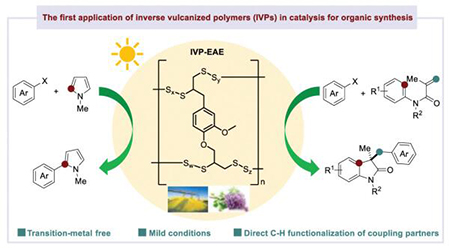
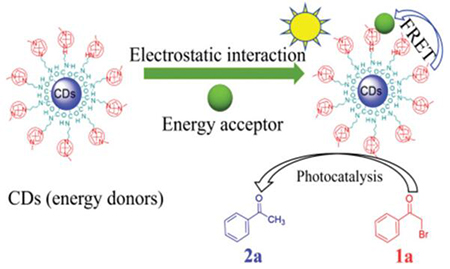
    Inverse vulcanized polymers (IVPs) that generated from elemental sulfur and smaller amounts of alkenes have found broad promising applications such as cathode materials for Li-S batteries, dynamic and repairable materials, optics applications, and metal sorption. However, their exploration in organic synthesis is still unprecedented. Here we first report the application of inverse vulcanized polymers in catalysis for organic transformations. A biomass-derived inverse vulcanized polymer (IVP-EAE) is found to be capable of catalyzing cross-coupling reactions in a transition-metal-free fashion under visible light. This method allows the direct CH functionalization of pyrroles and N-arylacrylamides with (hetero)aryl halides, respectively, leading to the formation of two sets of structurally important scaffolds including pyrrole-containing biaryls and 3,3'-disubstituted oxindoles with high selectivity. We anticipate this study will not only unveil the new potential of IVPs, but also offer a distinct type of catalysts for organic transformations.
  • Xiuzheng Deng, Yi Ke, Jiawen Ding, Yingtang Zhou, Hui Huang, Qian Liang, Zhenhui Kang
    中国化学快报. 2024, 35(04): 109064. https://doi.org/10.1016/j.cclet.2023.109064
    摘要 ( ) PDF全文 ( ) HTML 可视化 收藏
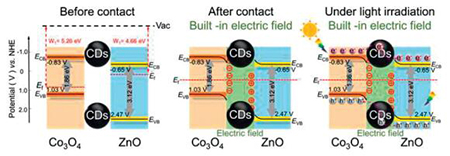
    Photocatalytic conversion of CO2 into small-molecule chemical feedstocks can meet the growing demand for energy and alleviate the global warming. Herein, a p-n ZnO@CDs@Co3O4 heterojunction with sandwich structure was constructed by calcination method of self-assembled ZIF-8@CDs@ZIF-67. The ZnO@CDs@Co3O4 with well-defined interfacial structure exhibited the significantly enhanced photocatalytic CO2 reduction activity, and the optimal catalyst indicated the (CO + CH4) evolution rate of 214.53 μmol g-1 h-1 under simulated solar light, which was superior to ZnO, Co3O4 and binary ZnO@Co3O4. The internal cavity, exposed active sites, multiple interfaces and constructed p-n heterojunction can facilitate the light harvesting and photoexcited electron transfer. Besides, after introduction of CDs placed in the middle layer between ZnO and Co3O4, CDs with excellent photoelectric property further promoted charge separation and migration. This work represents an appealing strategy to construct well-defined photocatalysts for boosting CO2 photoreduction.
  • Minying Wu, Xueliang Fan, Wenbiao Zhang, Bin Chen, Tong Ye, Qian Zhang, Yuanyuan Fang, Yajun Wang, Yi Tang
    中国化学快报. 2024, 35(04): 109258. https://doi.org/10.1016/j.cclet.2023.109258
    摘要 ( ) PDF全文 ( ) HTML 可视化 收藏
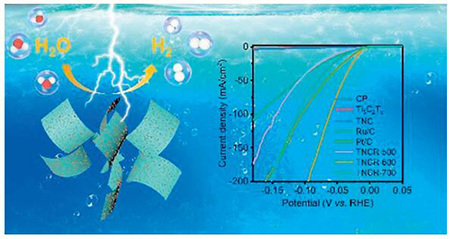
    Hydrogen has emerged as a promising environmentally friendly energy source. The development of low-cost, highly active, stable, and easily synthesized catalysts for hydrogen evolution reactions (HER) remains a significant challenge. This study explored the synthesis of nitrogen-doped MXene-based composite catalysts for enhanced HER performance. By thermally decomposing RuCl3 coordinated with melamine and formaldehyde resin, we successfully introduced nitrogen-doped carbon (NC) with highly dispersed ruthenium (Ru) onto the MXene surface. The calcination temperature played a crucial role in controlling the size of Ru nanoparticles (Ru NPs) and the proportion of Ru single-atom (Ru SA), thereby facilitating the synergistic enhancement of HER performance by Ru NPs and Ru SA. The resulting catalyst prepared with a calcination temperature of 600 ℃, Ti3C2Tx-N/C-Ru-600 (TNCR-600), exhibited exceptional HER activity (η10 = 17 mV) and stability (160 h) under alkaline conditions. This work presented a simple and effective strategy for synthesizing composite catalysts, offering new insights into the design and regulation of high-performance Ru-based catalysts for hydrogen production.
  • Wengao Zeng, Yuchen Dong, Xiaoyuan Ye, Ziying Zhang, Tuo Zhang, Xiangjiu Guan, Liejin Guo
    中国化学快报. 2024, 35(04): 109252. https://doi.org/10.1016/j.cclet.2023.109252
    摘要 ( ) PDF全文 ( ) HTML 可视化 收藏
    Achieving a high carrier migration efficiency by constructing built-in electric field is one of the promising approaches for promoting photocatalytic activity. Herein, we have designed a donor-acceptor (D-A) crystalline carbon nitride (APMCN) with 4-amino-2,6-dihydroxypyrimidine (AP) as electron donor, in which the pyrimidine ring was well embedded in the heptazine ring via hydrogen-bonding effect during hydrothermal process. The APMCN shows superior charge-transfer due to giant built-in electric field (5.94 times higher than pristine carbon nitride), thereby exhibiting excellent photocatalytic H2 evolution rate (1350 μmol/h) with a high AQY (62.8%) at 400nm. Mechanistic analysis based on detailed experimental investigation together with theoretical analysis reveals that the excellent photocatalytic activity is attributed to the promoted charge separation by the giant internal electric field originated from the D-A structure.
  • Junhan Luo, Qi Qing, Liqin Huang, Zhe Wang, Shuang Liu, Jing Chen, Yuexiang Lu
    中国化学快报. 2024, 35(04): 108483. https://doi.org/10.1016/j.cclet.2023.108483
    摘要 ( ) PDF全文 ( ) HTML 可视化 收藏
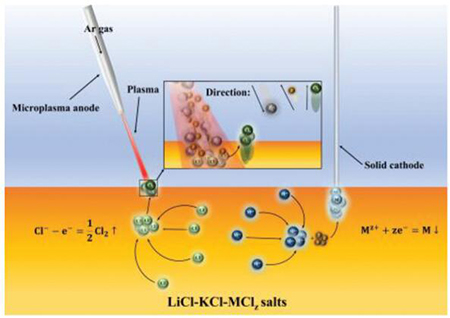
    Microplasma based on glow discharge could act as a non-contact gaseous electrode and has attracted much attention in both fundamental research and application. Herein, with microplasma as the anode, the electrodeposition process of a series of metal and metal alloys in molten salt has been systemically studied. Four metal cations with different valence states, silver (Ag+), nickel (Ni2+), copper (Cu2+), and iron (Fe3+), could all be reduced on the solid cathode with high current efficiency and the corresponding metal products were of high purity. The electrodeposition of aluminum-lanthanum (Al-Ln) alloy on the aluminum cathode was also successfully carried out with microplasma as the anode, and the same alloy was obtained by using the conventional anode electrode. These results indicated that microplasma anode based on non-contact direct-current (DC) glow discharge is a promising electrode to be applied in molten salt electrolysis.
  • Yanling Yang, Zhenfa Ding, Huimin Wang, Jianhui Li, Yanping Zheng, Hongquan Guo, Li Zhang, Bing Yang, Qingqing Gu, Haifeng Xiong, Yifei Sun
    中国化学快报. 2024, 35(04): 108585. https://doi.org/10.1016/j.cclet.2023.108585
    摘要 ( ) PDF全文 ( ) HTML 可视化 收藏
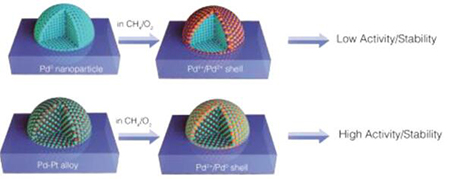
    Supported Pd based catalysts are considered as the efficient candidates for low-carbon alkane oxidation for their outstanding capability to break C-H bond. Whereas, the irreversible deactivation of Pd based catalysts was still frequently observed. Herein, we reinforced the extruded Pd nanoparticles with quantitive Pt to assemble the evenly distributed PdPt nanoalloy onto ferrite perovskite (PdPt-LCF) matrix with strengthened robustness of metal/oxide support interface. We further co-achieved the enhanced performance, anti-overoxidation as well as resistance of vapor-poisoning in durability measurement. The operando X-ray photoelectron spectroscopy (O-XPS) combined with various morphology characterizations confirms that the accumulation of surface deep-oxidation species of Pd4+ is the culprit for fast activity loss in exsolved Pd system, especially at high temperature of 400 ℃. Conversely, it could be completely suppressed by in-situ alloying Pd with equal amount of Pt, which helps maintain the metastable Pd2+/Pd shell and metallic solid-solution core structure. The density function theory (DFT) calculations further buttress that the dissociation of CH was facilitated on alloy/perovskite interface which is, on the contrary, resistant toward O-H bond cleavage, as compared to Pd/perovskite. Our work suggests that the modification of exsolved metal/oxide catalytic interface could further enrich the toolkit of heterogeneous catalyst design.
  • Chao-Long Chen, Rong Chen, La-Sheng Long, Lan-Sun Zheng, Xiang-Jian Kong
    中国化学快报. 2024, 35(04): 108795. https://doi.org/10.1016/j.cclet.2023.108795
    摘要 ( ) PDF全文 ( ) HTML 可视化 收藏
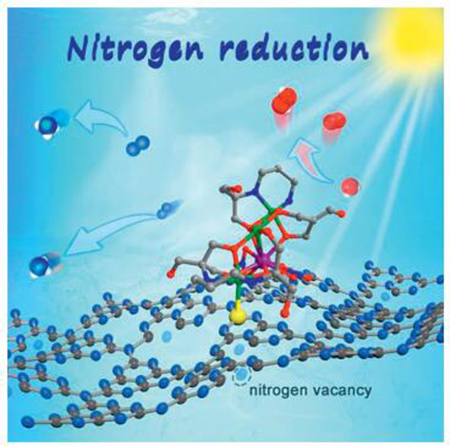
    Light-driven nitrogen fixation to produce ammonia is a green and economical technology of nitrogen reduction but is still quite challenging, especially in an air atmosphere without any sacrificial reagents. Herein, we demonstrate efficient photocatalytic nitrogen fixation using water and air directly by loading lanthanide-transition metal (4f-3d) cluster NdCo3 on two-dimensional P-doped graphitic carbon nitrides (PCN) material surface. Benefiting from the increase in the number of nitrogen vacancies (NVs) and highly matched band gap structure and excellent hole trapping ability of clusters, the NdCo3/PCN photocatalyst exhibits efficient nitrogen reduction activity with 371 (in air) and 825 μmol h-1 g-1 (in pure nitrogen) without any sacrificial reagents. The introduction of potassium sulfate inhibits hydrogen production and promotes nitrogen reduction activation. This work suggests that anchoring precisely structured clusters on 2D materials may enhance photocatalytic nitrogen reduction under normal temperature and pressure.
  • Zhihao Gu, Jiabo Le, Hehe Wei, Zehui Sun, Mahmoud Elsayed Hafez, Wei Ma
    中国化学快报. 2024, 35(04): 108849. https://doi.org/10.1016/j.cclet.2023.108849
    摘要 ( ) PDF全文 ( ) HTML 可视化 收藏
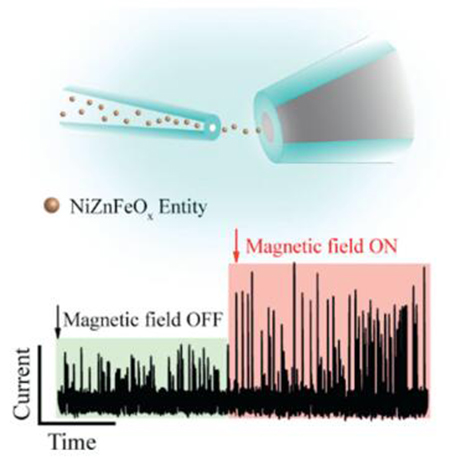
    Although considerable research efforts have been devoted to the design and development of non-noble electrocatalysts for oxygen evolution reaction (OER), substantial enhancement of OER performance with commercial-scale water electrolysis remains a big challenge. This could result from the difficulties in detecting the intrinsic properties and overlooking the assembly process for electrochemical OER process. Here, we employ a microjet collision method to investigate the intrinsic OER activities of individual NiZnFeOx entities with and without a moderate magnetic field. Our results demonstrate that single NiZnFeOx nanoparticles (NPs) show the excellent OER performance with a lowest onset potential (~1.35V vs. RHE) and a greatest magnetic enhancement (~118%) among bulk materials, single agglomerations and NPs. Furthermore, we explore the utility of theoretical investigation by density functional theory (DFT) calculations for studying OER process on NiZnFeOx surfaces without and with spin alignment, indicating monodispersed NiZnFeOx NPs with totally spin alignment facilitates the OER process under the external magnetic field. It is found that the well-dispersion of NiZnFeOx NPs would increase the electrical conductivity and the surface spin state, resulting in promoting their OER activities. This work provides a test for uncovering the essential roles of NPs assembly to a significant promotion of their magnet-assisted OER.
  • Qiang Cao, Xue-Feng Cheng, Jia Wang, Chang Zhou, Liu-Jun Yang, Guan Wang, Dong-Yun Chen, Jing-Hui He, Jian-Mei Lu
    中国化学快报. 2024, 35(04): 108759. https://doi.org/10.1016/j.cclet.2023.108759
    摘要 ( ) PDF全文 ( ) HTML 可视化 收藏
    Waste polyolefin plastics, accounting for 50% of all plastic waste, represent a tremendously unexploited carbon source. Efficiently upcycling polyolefin waste into value-added carbon materials for waste water treatment avoiding using noble metals is challenging but economically and environmentally sustainable. In this work, MAX-Ti3AlC2 supported Fe selectively catalyzes polyolefin into few-layered graphene in 5 min under microwave treatment. Graphene and MAX supported Fe (Fe@MLC) can completely (99.9%) degrade chloramphenicol (CAP) within 60 min, retain robust after 10 cycles and work efficiently at a wide pH range (3.87-13.03), avoiding the usage of noble metal. Moreover, the electrochemical active surface area (ECSA) of Fe@MLC is 2.7 times higher than that of commercial Pt/C. This work provides a cheap and efficient catalyst that promotes deconstruction of plastic wastes and indirectly degrades antibiotics thereby realizes the treatment of waste water with waste plastic.
  • Tingting Liu, Pengfei Sun, Wei Zhao, Yingshuang Li, Lujun Cheng, Jiahai Fan, Xiaohui Bi, Xiaoping Dong
    中国化学快报. 2024, 35(04): 108813. https://doi.org/10.1016/j.cclet.2023.108813
    摘要 ( ) PDF全文 ( ) HTML 可视化 收藏
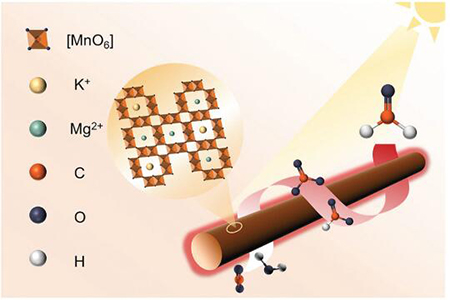
    Mg-doped manganese oxide octahedral molecular sieve (Mg-OMS-2) catalysts were prepared by hydrothermal method. The photothermal degradation performance of these catalysts for formaldehyde (HCHO) in batch system and continuous system was investigated. The light absorption of OMS-2 was increased by Mg-doped, especially for near infrared light, which promoted surface temperature reach a maximum of 214.8 ℃ under xenon irradiation. At this temperature, the reinforced surface lattice oxygen and oxygen vacancy that formed by lattice distortion via Mg-doped were activated. The best HCHO elimination efficiency was achieved over Mg0.2/OMS-2 catalyst with Mg2+/Mn2+ = 1/5, which could reduce HCHO from 250ppm to 10ppm within 20min. The in situ DRIFTS was also carried out to monitor the changes in the content of reaction intermediates and analyze the degradation paths of HCHO. It was found the HCHO was attacked by formed ·OH and ·O2- to generate formate species and carbonate species, and finally transformed to CO2 and H2O. This photothermal catalytic oxidation process exhibited a high efficiency purification of HCHO without the help of extra energy consumption.
  • Yinyin Xu, Yuanyuan Li, Jingbo Feng, Chen Wang, Yan Zhang, Yukun Wang, Xiuwen Cheng
    中国化学快报. 2024, 35(04): 108838. https://doi.org/10.1016/j.cclet.2023.108838
    摘要 ( ) PDF全文 ( ) HTML 可视化 收藏
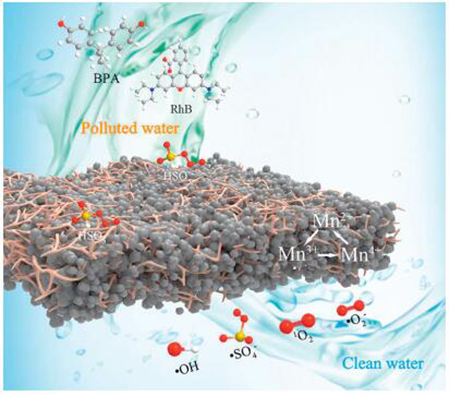
    A novel N, O modified Mn3O4@porous carbon catalyst (NOC-Mn3O4) was prepared by direct carbonization using the manganese-metal organic framework (Mn-MOF) and covalent organic framework (COF) as precursors to activate peroxymonosulfate (PMS) for the degradation of bisphenol A (BPA) and rhodamine B (RhB). Benefiting from the N and O co-doping of COF, larger specific surface area, faster electron transfer and Mn cycling, the optimum 1NOC-Mn3O4 could significantly improve the degradation performance of BPA and RhB (92.1% and 96.9% within 30 min) as compared to C-Mn3O4 without COF doping. In addition, 1NOC-Mn3O4 showed good reusability and strong anti-interference ability. Radical quenching experiments, X-ray photoelectron spectroscopy (XPS), Electron paramagnetic resonance spectrometer (EPR) and electrochemical tests showed that the 1NOC-Mn3O4/PMS system degraded BPA and RhB by both radical and non-radical pathways. Moreover, the possible degradation pathways of BPA and RhB were proposed by liquid chromatography-mass spectrometry (LC-MS). Except for that, the toxicity of BPA, RhB and their intermediates were evaluated. This study opens up a new prospect for the design of COF-doped PMS catalysts.
  • Ling Fang, Sha Wang, Shun Lu, Fengjun Yin, Yujie Dai, Lin Chang, Hong Liu
    中国化学快报. 2024, 35(04): 108864. https://doi.org/10.1016/j.cclet.2023.108864
    摘要 ( ) PDF全文 ( ) HTML 可视化 收藏
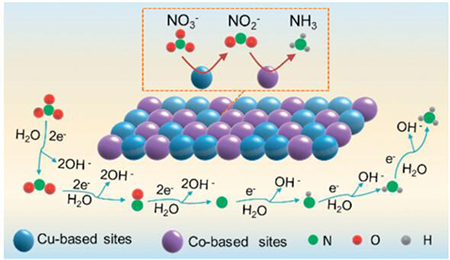
    Electrochemical conversion of nitrate (NO3-) to ammonia (NH3) can target two birds with one stone well, in NO3--containing sewage remediation and sustainable NH3 production. However, single metal-based catalysts are difficult to drive high-efficient NO3- removal due to the multi-electron transfer steps. Herein, we present a tandem catalyst with simple structure, Cu-Co binary metal oxides (Cu-Co-O), by engineering intermediate phases as catalytic active species for NO3- conversion. Electrochemical evaluation, X-ray photoelectron spectroscopy, and in situ Raman spectra together suggest that the newly-generated Cu-based phases was prone to NO3- to NO2- conversion, then NO2- was reduced to NH3 on Co-based species. At an applied potential of -1.1V vs. saturated calomel electrode, the Cu-Co-O catalyst achieved NO3--N removal of 90% and NH3 faradaic efficiency of 81% for 120min in 100mL of 50mg/L NO3--N, consuming only 0.69kWh/mol in a two-electrode system. This study provides a facile and efficient engineering strategy for developing high-performance catalysts for electrocatalytic nitrate conversion.
  • Linhui Liu, Wuwan Xiong, Mingli Fu, Junliang Wu, Zhenguo Li, Daiqi Ye, Peirong Chen
    中国化学快报. 2024, 35(04): 108870. https://doi.org/10.1016/j.cclet.2023.108870
    摘要 ( ) PDF全文 ( ) HTML 可视化 收藏
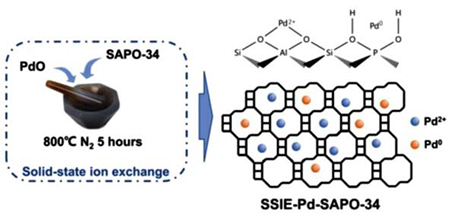
    Palladium-exchanged chabazite (Pd-CHA) zeolites as passive NOx adsorbers (PNAs) enable efficient purification of nitrogen oxides (NOx) in cold-start diesel exhausts. Their commercial application, however, is limited by the lack of facile preparation method. Here, high-performance CHA-type Pd-SAPO-34 zeolite was synthesized by a modified solid-state ion exchange (SSIE) method using PdO as Pd precursor, and demonstrated superior PNA performance as compared to Pd-SAPO-34 prepared by conventional wet-chemistry strategies. Structural characterization using Raman spectroscopy and X-ray diffraction revealed that the SSIE method avoided water-induced damage to the zeolite framework during Pd loading. Mechanistic investigations on the SSIE process by in situ infrared spectroscopy and X-ray photoelectron spectroscopy disclosed that, while PdO precursor was mainly converted to Pd2+ cations coordinated to the zeolite framework by consuming the -OH groups of the zeolite, a portion of PdO could also undergo thermal decomposition to form highly dispersed Pd0 clusters in the pore channels. This simplified and scalable SSIE method paves a new way for the cost-effective synthesis of defect-free high-performance Pd-SAPO-34 zeolites as PNA catalysts.
  • Tao Long, Peng Chen, Bin Feng, Caili Yang, Kairong Wang, Yulei Wang, Can Chen, Yaping Wang, Ruotong Li, Meng Wu, Minhuan Lan, Wei Kong Pang, Jian-Fang Wu, Yuan-Li Ding
    中国化学快报. 2024, 35(04): 109267. https://doi.org/10.1016/j.cclet.2023.109267
    摘要 ( ) PDF全文 ( ) HTML 可视化 收藏
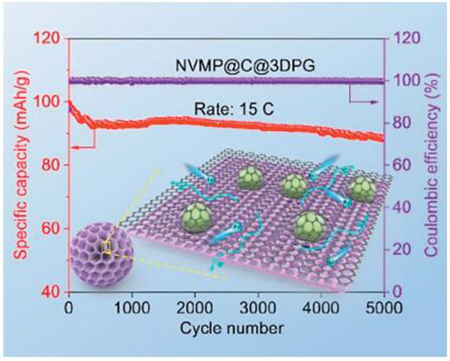
    Realizing high-rate capability and high-efficiency utilization of polyanionic cathode materials is of great importance for practical sodium-ion batteries (SIBs) since they usually suffer from extremely low electronic conductivity and limited ionic diffusion kinetics. Herein, taking Na3.5V1.5Mn0.5(PO4)3 (NVMP) as an example, a reinforced concrete-like hierarchical and porous hybrid (NVMP@C@3DPG) built from 3D graphene (“rebar”) frameworks and in situ generated carbon coated NVMP (“concrete”) has been developed by a facile polymer assisted self-assembly and subsequent solid-state method. Such hybrids deliver superior rate capability (73.9 mAh/g up to 20 C) and excellent cycling stability in a wide temperature range with a high specific capacity of 88.4 mAh/g after 5000 cycles at 15 C at room temperature, and a high capacity retention of 97.1% after 500 cycles at 1 C (-20 ℃), and maintaining a high reversible capacity of 110.3 mAh/g in full cell. This work offers a facile and efficient strategy to develop advanced polyanionic cathodes with high-efficiency utilization and 3D electron/ion transport systems.
  • Caixia Li, Yi Qiu, Yufeng Zhao, Wuliang Feng
    中国化学快报. 2024, 35(04): 108846. https://doi.org/10.1016/j.cclet.2023.108846
    摘要 ( ) PDF全文 ( ) HTML 可视化 收藏
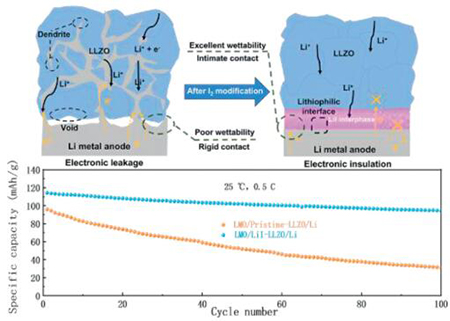
    The poor interfacial contact is one of the biggest challenges that solid-state lithium batteries suffer from. Reducing the solid-state electrolyte surface energy by transforming the interface from lithiophobic to lithiophilic is effective to promote the interfacial contact, but electronic conductive interphases usually increase the risk of electron attack, thus leading to uncontrollable Li dendrite growth. Herein, we propose a self-assembled thermodynamic stable LiI interphase to simultaneously improve the interfacial contact between the garnet electrolyte Li7La3Zr2O12 (LLZO) and Li anode, and prohibit the electron attack. The direct contact between LLZO and Li and the high temperature Li melting process was ascribed to Zr4+ reduction, which facilitated Li dendrite formation and propagation. With the modification of the high lithiophilic I2 thin film, the area specific interfacial resistance of LLZO/Li was reduced from 1525 Ω/cm2 to 57 Ω/cm2. More importantly, LLZO was protected from being reduced due to the outstanding electronic insulativity of the LiI interphase, which leaded to a high critical current density of 1.2/7.0mA/cm2 in the time/capacity-constant modes, respectively.
  • Fanjun Kong, Yixin Ge, Shi Tao, Zhengqiu Yuan, Chen Lu, Zhida Han, Lianghao Yu, Bin Qian
    中国化学快报. 2024, 35(04): 108552. https://doi.org/10.1016/j.cclet.2023.108552
    摘要 ( ) PDF全文 ( ) HTML 可视化 收藏
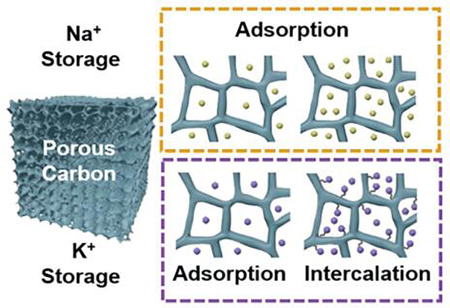
    Tin-based chalcogenides have attracted tremendous attention as an anode material for sodium storage owing to their unique structure and high theoretical capacity. Unfortunately, the large volume change and poor conductivity lead to sluggish reaction kinetics and poor cycling performance. Herein, SnS0.5Se0.5 nanoparticles coupled with N/S/Se triple-doped carbon nanofibers (SnS0.5Se0.5@NSSe-C) are designed and synthesized through electrospinning and annealing process. Benefiting from the synergistic effects of SnS0.5Se0.5 and NSSe-C, the SnS0.5Se0.5@NSSe-C nanofibers exhibit a high reversible capacity and ultralong cycle life at higher current density for sodium-ion batteries. Furthermore, the sodium storage mechanism and electrochemical reaction kinetics of the SnS0.5Se0.5@NSSe-C composite are characterized by the in-situ measurements. The theoretical calculations further reveal the structural advantages of SnS0.5Se0.5@NSSe-C composite, which exhibits a high adsorption energy of Na+. This work can provide a novel idea for the synthesis of ternary tin-based chalcogenides and is beneficial for the investigation of their reaction kinetics.
  • Ziling Jiang, Shaoqing Chen, Chaochao Wei, Ziqi Zhang, Zhongkai Wu, Qiyue Luo, Liang Ming, Long Zhang, Chuang Yu
    中国化学快报. 2024, 35(04): 108561. https://doi.org/10.1016/j.cclet.2023.108561
    摘要 ( ) PDF全文 ( ) HTML 可视化 收藏
    LiNi0.8Co0.15Al0.05O2 (NCA) is a promising cathode for sulfide-based solid-state lithium batteries (ASSLBs) profiting from its high specific capacity and voltage plateau, which yielding high energy density. However, the inferior interfacial stability between the bare NCA and sulfides limits its electrochemical performance. Hereien, the dual-electrolyte layer is proposed to mitigate this effect and enhance the battery performances of NCA-based ASSLIBs. The Li3InCl6 wih high conductivity and excellent electrochemcial stability act both as an ion additives to promote Li-ion diffusion across the interface in the cathode and as a buffer layer between the cathode layer and the solid electrolyte layer to avoid side reactions and improve the interface stability. The corresponding battery exhibits high discharge capacities and superior cyclabilities at both room and elevated temperatures. It exhibits discharge performance of 237.04 and 216.07 mAh/g at 0.1 and 0.5 C, respectively, when cycled at 60 ℃, and sustains 95.9% of the capacity after 100 cycles at 0.5 C. The work demonstrates a simple strategy to ensure the superior performances of NCA in sulfide-based ASSLBs.
  • Jun Jiang, Tong Guo, Wuxin Bai, Mingliang Liu, Shujun Liu, Zhijie Qi, Jingwen Sun, Shugang Pan, Aleksandr L. Vasiliev, Zhiyuan Ma, Xin Wang, Junwu Zhu, Yongsheng Fu
    中国化学快报. 2024, 35(04): 108565. https://doi.org/10.1016/j.cclet.2023.108565
    摘要 ( ) PDF全文 ( ) HTML 可视化 收藏
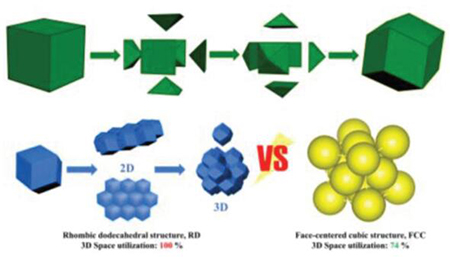
    Popularization of lithium-sulfur batteries (LSBs) is still hindered by shuttle effect and volume expansion. Herein, a new modularized sulfur storage strategy is proposed to solve above problems and accomplished via employing 100% space utilization host material of cobalt loaded carbon nanoparticles derived from ZIF-67. The modular dispersed storage of sulfur not only greatly increases the proportion of active sulfur, but also inhibits the occurrence of volume expansion. Meanwhile, 100% space utilization host material can greatly improve the conductivity of the cathode, provide a larger electrolyte wetting interface and effectively suppress the shuttle effect. Moreover, loaded cobalt particles have high catalytic activity for electrochemical reaction and can effectively improve the redox kinetics. The cell with new cathode host material carbonized at 650 ℃ (ZIF-67 (650 ℃)) exhibits superior rate performance and can maintain a high specific capacity of 950 mAh/g after 100 cycles at 0.2 C, showing a good cycle stability.
  • Zhe Wang, Li-Peng Hou, Qian-Kui Zhang, Nan Yao, Aibing Chen, Jia-Qi Huang, Xue-Qiang Zhang
    中国化学快报. 2024, 35(04): 108570. https://doi.org/10.1016/j.cclet.2023.108570
    摘要 ( ) PDF全文 ( ) HTML 可视化 收藏
    Electrolyte design is essential for stabilizing lithium metal anodes and localized high-concentration electrolyte (LHCE) is a promising one. However, the state-of-the-art LHCE remains insufficient to ensure long-cycling lithium metal anodes. Herein, regulating the solvation structure of lithium ions in LHCE by weakening the solvating power of diluents is proposed for improving LHCE performance. A diluent, 1,1,2,2,3,3,4,4-octafluoro-5-(1,1,2,2-tetrafluoroethoxy) pentane (OFE), with weaker solvating power is introduced to increase the proportion of aggregates (an anion interacts with more than two lithium ions, AGG-n) in electrolyte compared with the commonly used 1,1,2,2-tetrafluoroethyl-2,2,3,3-tetrafluoropropyl ether (TTE). The decomposition of AGG-n in OFE-based LHCE intensifies the formation of anion-derived solid electrolyte interphase and improves the uniformity of lithium deposition. Lithium metal batteries with OFE-based LHCE deliver a superior lifespan of 190 cycles compared with 90 cycles of TTE-based LHCE under demanding conditions. Furthermore, a pouch cell with OFE-based LHCE delivers a specific energy of 417Wh/kg and undergoes 49 cycles. This work provides guidance for designing high-performance electrolytes for lithium metal batteries.
  • Lumin Zheng, Ying Bai, Chuan Wu
    中国化学快报. 2024, 35(04): 108589. https://doi.org/10.1016/j.cclet.2023.108589
    摘要 ( ) PDF全文 ( ) HTML 可视化 收藏
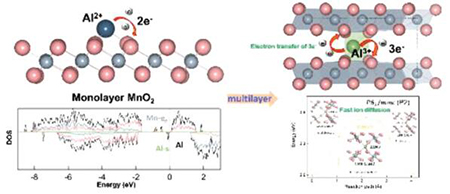
    Rechargeable aluminum batteries with multi-electron reaction have a high theoretical capacity for next generation of energy storage devices. However, the diffusion mechanism and intrinsic property of Al insertion into MnO2 are not clear. Hence, based on the first-principles calculations, key influencing factors of slow Al-ions diffusion are narrow pathways, unstable Al-O bonds and Mn3+ type polaron have been identified by investigating four types of δ-MnO2 (O3, O’3, P2 and T1). Although Al insert into δ-MnO2 leads to a decrease in the spacing of the Mn-Mn layer, P2 type MnO2 keeps the long (spacious pathways) and stable (2.007-2.030Å) Al-O bonds resulting in the lower energy barrier of Al diffusion of 0.56 eV. By eliminated the influence of Mn3+ (low concentration of Al insertion), the energy barrier of Al migration achieves 0.19eV in P2 type, confirming the obviously effect of Mn3+ polaron. On the contrary, although the T1 type MnO2 has the sluggish of Al-ions diffusion, the larger interlayer spacing of Mn-Mn layer, causing by H2O could assist Al-ions diffusion. Furthermore, it is worth to notice that the multilayer δ-MnO2 achieves multi-electron reaction of 3|e|. Considering the requirement of high energy density, the average voltage of P2 (1.76V) is not an obstacle for application as cathode in RABs. These discover suggest that layered MnO2 should keep more P2-type structure in the synthesis of materials and increase the interlayer spacing of Mn-Mn layer for providing technical support of RABs in large-scale energy storage.
  • Qiangwei Wang, Huijiao Liu, Mengjie Wang, Haojie Zhang, Jianda Xie, Xuanwei Hu, Shiming Zhou, Weitai Wu
    中国化学快报. 2024, 35(04): 108743. https://doi.org/10.1016/j.cclet.2023.108743
    摘要 ( ) PDF全文 ( ) HTML 可视化 收藏
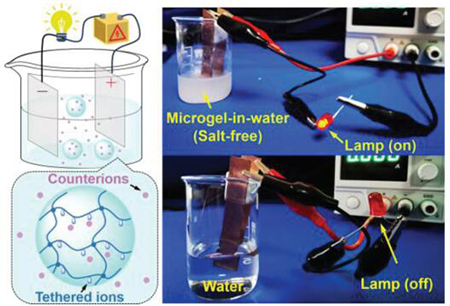
    Here, we report an observation that illustrate the potential of polyelectrolyte microgels in salt-free solutions to display a high ionic conductivity. Laser light scattering and ionic conductivity tests on very dilute aqueous dispersions of the microgels indicate that both small size and swollen state of gel particles play vital roles, which should favor the counterions to freely penetrate and leave gel particles, and thus can contribute to the ion-conducting property. Upon discovering this on microgels that are composed of imidazolium-based poly(ionic liquid), we also illustrate the generality of the finding to single lithium-ion polyelectrolyte microgels that are of more technically relevant features for applications, for instance, as injectable liquid “microgel-in-solution” electrolytes of high conductivity (ca. 8.2× 10⁻² S/m at 25.0 ℃ for 1.0× 10⁻²g/mL of microgels in a LiNO3-free 1:1 v/v mixture of 1,2-dioxolane and dimethoxymethane) and high lithium-ion transference number (0.87) for use in the rechargeable lithium-sulfur battery.
  • Dexuan Xiao, Tianyu Chen, Tianxu Zhang, Sirong Shi, Mei Zhang, Xin Qin, Yunkun Liu, Longjiang Li, Yunfeng Lin
    中国化学快报. 2024, 35(04): 108602. https://doi.org/10.1016/j.cclet.2023.108602
    摘要 ( ) PDF全文 ( ) HTML 可视化 收藏
    Melanoma is one of the most malignant skin tumors, whose high invasion is generally associated with BRAF gene mutation. Although new chemotherapeutic drugs, such as vemurafenib, have been developed to inhibit the growth of melanoma, these drugs are usually administered intravenously or orally, resulting in toxic side effects on major tissues and organs. Tetrahedral framework nucleic acids (tFNAs) are a novel type of DNA nanostructures with excellent biocompatibility and versatility which have been proven to penetrate through skin barrier with ease. In this study, we prepared tFNAs with vemurafenib and connected DNA aptamer AS1411 at the apex of tFNAs (AS1411-tFNAs/vemurafenib). On one hand, AS1411-tFNAs/vemurafenib could kill melanoma cells by blocking the mutated BRAF gene in vitro. Compared with free vemurafenib, AS1411-tFNAs/vemurafenib had no obvious toxicity to normal cells. On the other hand, AS1411-tFNAs could transfer vemurafenib to cross through the skin barrier and permeate into tumor tissues. In vivo, transdermal delivery of AS1411-tFNAs/vemurafenib could inhibit the growth of human A375 melanoma, whose inhibiting effect was stronger than intravenous administration of vemurafenib. These results demonstrated the application prospects of tFNAs combined with chemotherapeutic drugs in skin tumors.
  • Xinyue Lan, Junguang Liang, Churan Wen, Xiaolong Quan, Huimin Lin, Qinqin Xu, Peixian Chen, Guangyu Yao, Dan Zhou, Meng Yu
    中国化学快报. 2024, 35(04): 108616. https://doi.org/10.1016/j.cclet.2023.108616
    摘要 ( ) PDF全文 ( ) HTML 可视化 收藏
    Despite the synergy of immune checkpoint blockade (ICB) therapy and photodynamic therapy (PDT) holds great promise as countermeasures against breast cancer, exploring long-term or flexible short-time therapeutic strategies in “cold” tumors remains a great challenge. Here, we present a polyunsaturated fatty acid-doped liposomal hydrogel Lp(DHA)@CP Gel loaded with photosensitizer chlorin e6 (Ce6) and programmed death-ligand 1 antibody (αPD-L1) for flexible local photoimmunotherapy with merely single-dosed administration. The presence of polyunsaturated fatty acid (docosahexaenoic acid, DHA) doped in particle membrane endows liposomes with flexibly reactive oxygen species (ROS)-responsive release capability, which was attributed to the presence of abundant unsaturated groups. The αPD-L1 was repeatedly induced to in situ release in response to the PDT under photo-exposure. The immunogenic cell death (ICD) effect of PDT evoked “cold” breast tumor to “hot” one, and then assisted the cascade released αPD-L1 to synergistically boost the immunotherapy. After a single dose of peritumoral administration of Lp(DHA)@CP Gel, the on-demand treatment can maximize patient compliance and safety by adjusting therapeutic behaviors via a photo on-off switch. This work presents a flexible medication platform, showing promise in improving the objective response rate of ICB therapy and minimizing its systemic toxicity.
  • Yixin Zhang, Ting Wang, Jixiang Zhang, Pengyu Lu, Neng Shi, Liqiang Zhang, Weiran Zhu, Nongyue He
    中国化学快报. 2024, 35(04): 108619. https://doi.org/10.1016/j.cclet.2023.108619
    摘要 ( ) PDF全文 ( ) HTML 可视化 收藏
    In the physiological environment, nanoparticles (NPs) interact with proteins to form a protein-rich layer on the surface which is called "protein corona". Understanding and analyzing the formation process of protein corona and protein corona-nanoparticles is of great significance for biological related nano research. Many separation techniques have been used to analyze the composition of protein corona, but in situ analysis of protein corona is still absent. With the development of detection technology, sum frequency generation (SFG) is an effective instrument to analyze the surface protein structure and dynamic changes of protein corona in situ. In this work the molecular mechanism and surface structure effect of the interaction between nanoparticles with surface protein corona (S-NPP) and phospholipid membrane were studied. When S-NPP interacts with phospholipid membrane, the bond affinity network formed by the binding water can stabilize S-NPP around the lipid bilayer. In this process, S-NPP can be found wrapped in the hydration shell. This ultimately leads to a more moderate interaction between particles and phospholipid membrane.
  • Wenjia Wang, Xingyue He, Xiaojie Wang, Tiantian Zhao, Osamu Muraoka, Genzoh Tanabe, Weijia Xie, Tianjiao Zhou, Lei Xing, Qingri Jin, Hulin Jiang
    中国化学快报. 2024, 35(04): 108656. https://doi.org/10.1016/j.cclet.2023.108656
    摘要 ( ) PDF全文 ( ) HTML 可视化 收藏
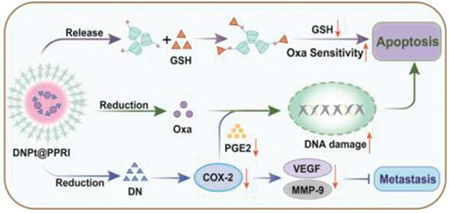
    Oxaliplatin (Oxa) is the first-line chemotherapeutic drug for the treatment of colorectal cancer (CRC). However, long-term Oxa chemotherapy can induce inflammation and increase the levels of cyclooxygenase-2 (COX-2) and prostaglandin E2 (PGE2), which can promote tumor metastasis. Moreover, high glutathione (GSH) levels in CRC cells significantly reduce Oxa sensitivity and seriously restrict the clinical application of Oxa. Herein, an Oxa(IV) prodrug with anti-inflammatory properties (desmethyl naproxe, DN) and GSH-depleting cyclodextrin pseudo-polyrotaxane carriers were prepared and further self-assembled into micellar nanoparticles (designated DNPt@PPRI). The relesae of DN from DNPt@PPRI can reduce the level of PGE2 to inhibit inflammation and tumor metastasis by decreasing COX-2 protein, and also synergize with Oxa to inhibit tumor. More importantly, GSH depletion can reduce the detoxification of Oxa and further enhance chemotherapy-induced apoptosis. DNPt@PPRI have a good GSH depletion ability to enhance the sensitivity of Oxa, indicating a potential in the synergistic chemotherapy and chemo-sensitization of colorectal cancer.
  • Lu Li, Suticha Chunta, Xianzi Zheng, Haisheng He, Wei Wu, Yi Lu
    中国化学快报. 2024, 35(04): 108662. https://doi.org/10.1016/j.cclet.2023.108662
    摘要 ( ) PDF全文 ( ) HTML 可视化 收藏
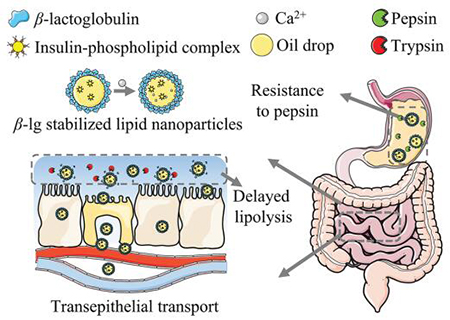
    Lipid-based nanocarriers have staged a remarkable comeback in the oral delivery of proteins and peptides, but delivery efficiency is compromised by lipolysis. β-Lactoglobulin (β-lg) stabilized lipid nanoparticles, including nanoemulsions (NE@β-lg) and nanocapsules (NC@β-lg), were developed to enhance the oral absorption of insulin by slowing down lipolysis due to the protection from β-lg. Cremophor EL stabilized nanoemulsions (NE@Cre-EL) were prepared and set as a control. The lipid nanoparticles produced mild and sustained hypoglycemic effects, amounting to oral bioavailability of 3.0% ±0.3%, 7.0% ±1.1%, and 7.7% ±0.8% for NE@Cre-EL, NE@β-lg, and NC@β-lg, respectively. Aggregation-caused quenching (ACQ) probes enabled the identification of intact nanoparticles, which were used to investigate the in vivo and intracellular fates of the lipid nanoparticles. In vitro digestion/lipolysis and ex vivo imaging confirmed delayed lipolysis from β-lg stabilized lipid nanoparticles. NC@β-lg was more resistant to intestinal lipolysis than NE@β-lg due to the Ca2+-induced crosslinking. Live imaging revealed the transepithelial transport of intact nanoparticles and their accumulation in the liver. Cellular studies confirmed the uptake of intact nanoparticles. Slowing down lipolysis via food proteins represents a good strategy to enhance the oral absorption of lipid nanoparticles and thus co-formulated biomacromolecules.
  • Yi Cao, Xiaojiao Ge, Yuanyuan Wei, Lulu He, Aiguo Wu, Juan Li
    中国化学快报. 2024, 35(04): 108672. https://doi.org/10.1016/j.cclet.2023.108672
    摘要 ( ) PDF全文 ( ) HTML 可视化 收藏
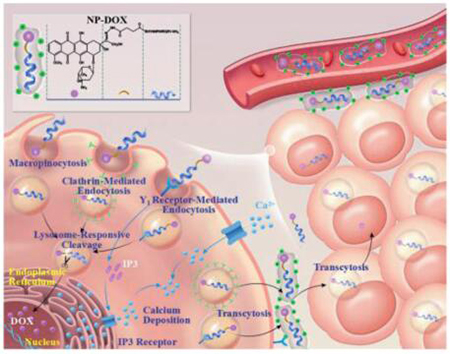
    Peptide-drug conjugates have achieved considerable development and application as a novel strategy for targeted delivery of anticancer drugs. Bioactive peptides induced calcium deposition can irreversibly assist inhibition of tumors. However, active regulation of calcium level through signal transduction of bioactive substances has not been reported yet. In this study, novel neuropeptide-doxorubicin conjugates (NP-DOX) with lysosome-specific acid response were described for neuropeptide Y1 receptor (Y1R)-overexpressed triple-negative breast cancer. The delivery mechanism of NP-DOX was clarified that diverse pathways were involved, including intracellular and intercellular transport. Importantly, up-regulation of Y1R-mediated intracellular calcium level via second messenger inositol triphosphate was presented in NP-DOX treated MDA-MB-231 cells. In vivo antitumor efficacy demonstrated that NP-DOX showed less organ toxicity and enhanced tumor inhibition benefited from its controlled release and Y1R-mediated calcium deposition, compared with free DOX. This bioconjugate is a proof-of-concept confirming that neuropeptide-mediated control of signaling responses in neuropeptide-drug conjugates enables great potential for further applications in tumor chemotherapy.
  • Xuebing Jiang, Siyi Wang, Li Zhang, Xian Jiang, Maling Gou
    中国化学快报. 2024, 35(04): 108686. https://doi.org/10.1016/j.cclet.2023.108686
    摘要 ( ) PDF全文 ( ) HTML 可视化 收藏
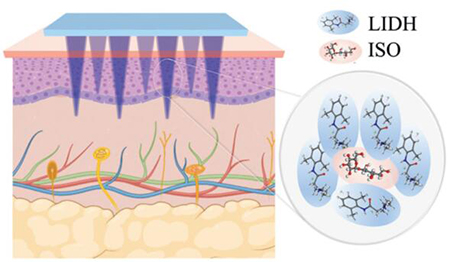
    Lidocaine hydrochloride (LIDH) as an anesthetic is widely used in local anesthesia. Dissolving microneedles (MNs) have great application value in the field of skin anesthesia. However, the limited drug-loading of dissolving MNs is an existing challenge that affects clinical use. In this study, we have screened isomaltulose (ISO) as the proper matrix material for the MNs by using molecular dynamics (MD) simulation. Our findings indicate that ISO has good compatibility with LIDH, and the LIDH-loaded ISO MNs (LI-MNs) have high drug-loading capacity. The drug-loading capacity of LI-MNs could reach 80%, and it could effectively puncture the skin. In addition, the preparation method of customized LI-MNs was established based on three-dimensional (3D) printing technology. It was shown that the administration time of LI-MNs could be controlled within 3 min. Also, the LI-MNs were able to provide the local anesthetic efficacy within 2 min and sustained for more than 2 h. Significantly, LI-MNs had more efficient drug efficacy compared to the topical creams and the majority of existing LIDH-loaded dissolving MNs. They even provided a longer duration of action than the injections. Overall, the LI-MNs with high drug-loading have a promising application prospect.
  • Feng Cui, Fangman Chen, Xiaochun Xie, Chenyang Guo, Kai Xiao, Ziping Wu, Yinglu Chen, Junna Lu, Feixia Ruan, Chuanxu Cheng, Chao Yang, Dan Shao
    中国化学快报. 2024, 35(04): 108681. https://doi.org/10.1016/j.cclet.2023.108681
    摘要 ( ) PDF全文 ( ) HTML 可视化 收藏
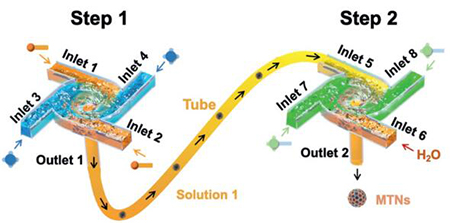
    Mesoporous titanium nanoparticles (MTNs) have emerged as an important porous semiconductor owning to their large surface area and unique electronic/optical properties. However, the fundamental research for rational manufacturing MTNs in a highly scalable manner remains a challenge. In this study, we report a two-step flash nanocomplexation (FNC) approach to large-scalable generate MTNs through the sequential combination of two multi-inlet vortex mixers. By optimizing the concentrated titanium precursor, polyethylene glycol (PEG)-functionalized silane amount and pH, we have been able to produce MTNs with small particle size (31.5nm), larger surface area (416.9 m2/g) and pore volume (0.59 cm3/g). Different from the traditional MTNs bulk, FNC-produced MTNs exhibited well-controlled manner and exceptional photocatalytic and antibacterial properties. Importantly, the optimized MTNs outperformed commercial P25 not only in protecting ultraviolet A (UVA)-exposed skin, but also in treating P. aeruginosa-infected wound. We believe that the high controllability and scalability of sequential flash nanocomplexation method offers great opportunities in enhancing the performance of mesoporous titanium nanoparticles.
  • Songtao Cai, Liuying Wu, Yuan Li, Soham Samanta, Jinying Wang, Bing Liu, Feihu Wu, Kaitao Lai, Yingchao Liu, Junle Qu, Zhigang Yang
    中国化学快报. 2024, 35(04): 108599. https://doi.org/10.1016/j.cclet.2023.108599
    摘要 ( ) PDF全文 ( ) HTML 可视化 收藏
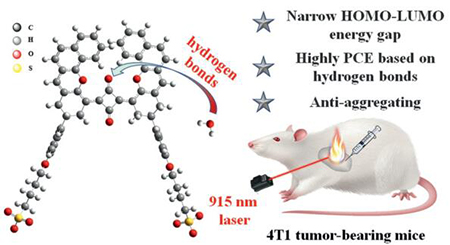
    The photothermal therapy (PTT) has come across as a promising noninvasive therapeutic strategy for tumor treatment. However, low photothermal conversion efficiency (PCE) and hydrophobicity may impede the therapeutic efficacy of organic photothermal agents and an efficient PTT-agent must overcome these two major challenges. In this work, we developed a new strategy to promote higher PCE wherein the intermolecular hydrogen-bonding interaction between the single dye molecule and water facilitated the transformation of the absorbed energy into the heat. A hydrophilic squaraine dye (SCy1) with the second near-infrared region (NIR-II) absorption and extremely low emission were designed to exhibit much higher PCE than that of the analogues of pentamethine-dyes (PCy1, PCy2). The presence of the ‘-O-’ at middle of squaric cycle enabled the intermolecular H-bonding formation between the SCy1 and water to promote the energy dissipation channel. Moreover, the introduction of long-chain phenylsulfonate groups helped in to improve the water solubility apart from serving as an additional means of further enhancing PCE through fluorescence quenching. Therefore, SCy1 with a squaraine backbone and long-chain sulfonate moieties revealed outstanding photothermal stability and anti-aggregation activity apart from showing exceptionally high PCE (74%) in water. SCy1 demonstrated excellent therapeutic efficacy when applied in the PTT treatment of tumor-bearing mice under a laser irradiation of 915nm.
  • Ling-Ling Wu, Xiangchuan Meng, Qingyang Zhang, Xiaowan Han, Feiya Yang, Qinghua Wang, Hai-Yu Hu, Nianzeng Xing
    中国化学快报. 2024, 35(04): 108663. https://doi.org/10.1016/j.cclet.2023.108663
    摘要 ( ) PDF全文 ( ) HTML 可视化 收藏
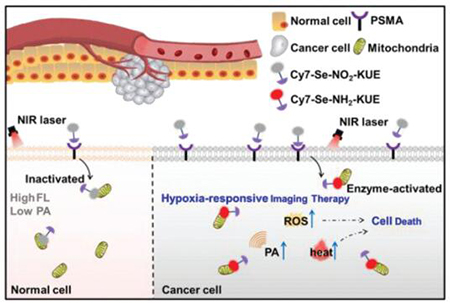
    Photoacoustic agents combining photodynamic therapy (PDT) and photothermal therapy (PTT) functions have emerged as potent theranostic agents for combating cancer. The molecular approaches for enhancing the near-infrared (NIR)-absorption and maximizing non-radiative energy transfer are essential for effective photoacoustic imaging (PAI) and therapy applications. In addition, such molecules with high specificity and affinity to cancer cells are urgently needed, which would further decrease the side effect during treatments. In this study, we applied a heavy-atom engineering strategy and introduced p-aminophenol, -thio, and -seleno moieties into NIR heptamethine cyanine (Cy7) skeleton (Cy7-X-NH2, X = O, S, Se) to significantly increase photothermal conversion efficiency for PTT and promote intersystem crossing for PDT. Additionally, we designed a series of nitroreductase (NTR)-activated photoacoustic probes (Cy7-X-NO2, X = O, S, Se), and target hypoxic tumors with NTR overexpression. Our prostate cancer targeting probe, Cy7-Se-NO2-KUE, exhibited specific tumor photoacoustic signals and effective tumor killing through outstanding synergistic PTT/PDT in vivo. These findings highlighted a versatile strategy for cancer photoacoustic diagnosis and enhanced phototherapy.
  • Lixian Fu, Yiyun Tan, Yue Ding, Weixia Qing, Yong Wang
    中国化学快报. 2024, 35(04): 108886. https://doi.org/10.1016/j.cclet.2023.108886
    摘要 ( ) PDF全文 ( ) HTML 可视化 收藏
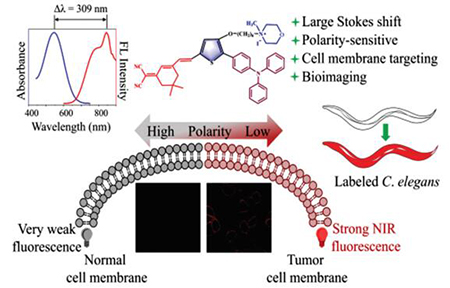
    A novel D-π-A structure and near-infrared fluorescent probe (DCITT) with high polarity sensitivity and membrane targeting was reported. The fluorescent spectra of DCITT were polarity dependent and Stokes shift was greater than 300 nm. Due to its high fluorescence quantum yield, low cytotoxicity and photostability, DCITT could be used as a labeling probe in multicellular organisms. In particular, DCITT effectively distinguished tumor cells from normal cells because it could specifically light up the cancer cells membrane based on strong red fluorescence for a long time. On this basis, a polar-sensitive cell membrane probe is developed to differentiate tumor cells from normal cells, which provides an idea and method for the early diagnosis of tumor at cellular level.
  • Zihong Li, Jie Cheng, Ping Huang, Guoliang Wu, Weiying Lin
    中国化学快报. 2024, 35(04): 109153. https://doi.org/10.1016/j.cclet.2023.109153
    摘要 ( ) PDF全文 ( ) HTML 可视化 收藏
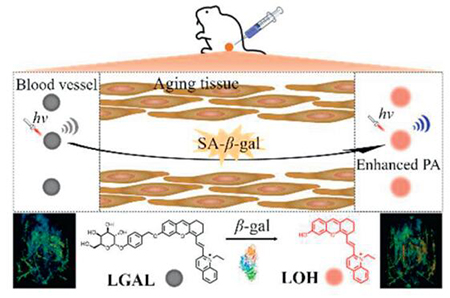
    Aging is a natural physiological process with various challenges, related to the loss of homeostasis within the organism, which is not a disease, but a significantly strong risk factor for multiple diseases, including myocardial infarction, stroke, some age-related cancers, macular degeneration, osteoarthritis, neurodegeneration, and many others. In the body, the main manifestation of aging is cellular aging, which exists within tissues and has a local or global impact on tissue function. However, the lack of effective aging detection tools has always been an issue that cannot be ignored in the field of aging research. Therefore, it is necessary to construct a non-invasive tool for in vivo detection of aging. Here, we show that the photoacoustic probe (LGAL), which has peak excitation and emission wavelengths in the near-infrared optical window, binds in vivo and at high contrast to the hallmark of aging, and allows for the microscopic imaging of aging through the intact mice. Firstly, this tool LGAL has been successfully applied to detect senescence in cells, displaying stronger photoacoustic signals than normal cells. Then, by using the photoacoustic probe, the blood vessels and tissues inside the mice can be visualized. Young and elderly mice exhibit varying intensities of photoacoustic signals, marking the first time a probe has been used to explore the aging of blood vessels and tissues inside the mice. Finally, we monitored the changes in the degree of aging during tumor treatment under photoacoustic (PA) imaging for the first time. As the treatment time increased, the degree of aging of the tumor gradually deepened. We expect the powerful tool could be a noninvasive and powerful tool for the study of aging biology.
  • Yaping Zhang, Wei Zhou, Mingchun Gao, Tianqi Liu, Bingxin Liu, Chang-Hua Ding, Bin Xu
    中国化学快报. 2024, 35(04): 108836. https://doi.org/10.1016/j.cclet.2023.108836
    摘要 ( ) PDF全文 ( ) HTML 可视化 收藏
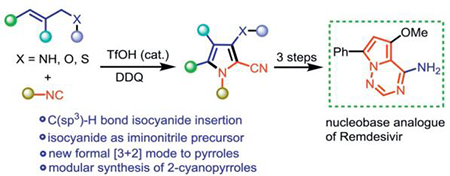
    A facile TfOH-catalyzed oxidative cyclization of allyl compounds and isocyanide has been developed with the assistance of DDQ, where isocyanide is used as the crucial "N" and "CN" sources. Highly functionalized 2-cyanopyrroles are constructed efficiently through a new formal [3 + 2] mode, demonstrating diverse reactivity and synthetic utility in organic chemistry. 2-Cyanopyrrole is converted into a nucleobase analogue of Remdesivir and 5H-pyrrolo[2,1-a]isoindole through a three-step or a two-step sequence, respectively. This protocol features broad substrate scope, operational simplicity and good functional group tolerance.
  • Jingping Hu, Jing Xu
    中国化学快报. 2024, 35(04): 108733. https://doi.org/10.1016/j.cclet.2023.108733
    摘要 ( ) PDF全文 ( ) HTML 可视化 收藏
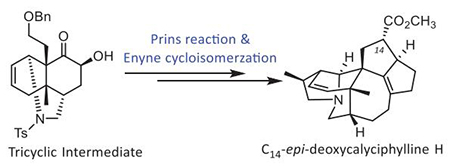
    One of the largest subfamilies within the famous Daphniphyllum alkaloid family is made up of the yuzurimine-type (or macrodaphniphyllamine-type) alkaloids. Their complex aza-polycyclic caged structures, several contiguous stereogenic centers, and vicinal all-carbon quaternary centers make these alkaloids formidable challenge for synthetic chemists. Recently, synthesis of these alkaloids has received extensive attention from our community. Herein, we wish to report the total synthesis of C14-epi-deoxycalyciphylline H, a putative member of yuzurimine-type alkaloid subfamily. Key transformations employed in our approach include an intramolecular Prins reaction and a Pd-catalyzed enyne cycloisomerization. In addition, synthesis of a daphnezomine L-type alkaloid, paxdaphnidine A, was also studied.
  • Tong Li, Leping Pan, Yan Zhang, Jihu Su, Kai Li, Kuiliang Li, Hu Chen, Qi Sun, Zhiyong Wang
    中国化学快报. 2024, 35(04): 108897. https://doi.org/10.1016/j.cclet.2023.108897
    摘要 ( ) PDF全文 ( ) HTML 可视化 收藏
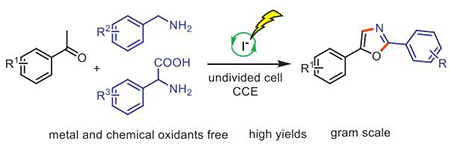
    An efficient NH and C(sp3)-H functionalization of aryl ketones with benzylamines/amino acids was developed under mild conditions by virtue of anodic oxidation. A variety of functionalized 2,5-diaryloxazoles were obtained with good to excellent yields. Moreover, some important natural products can be prepared by this method. The reaction features a broad substrate scope, scalability, metal-free and chemical oxidant-free.
  • Lei Shen, Yang Zhang, Linlin Zhang, Chuanwang Liu, Zhixian Ma, Kangjiang Liang, Chengfeng Xia
    中国化学快报. 2024, 35(04): 108742. https://doi.org/10.1016/j.cclet.2023.108742
    摘要 ( ) PDF全文 ( ) HTML 可视化 收藏
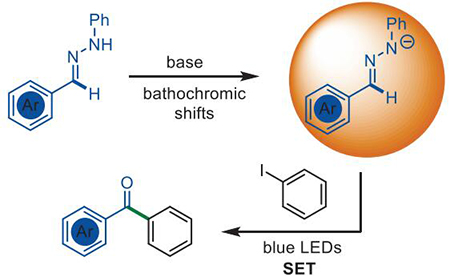
    Spectroscopic investigations discovered that the in-situ generated phenylhydrazone anion was significantly bathochromically shifted to visible light region for photoactivation under irradiation. The photoexcited phenylhydrazone anion was potential to reduce aryl iodides via single electron transfer process for the subsequent radical chain reaction. A redox-neutral photochemical carbonylation of aryl iodides was developed on basis of the special spectroscopic features of phenylhydrazone anion. This protocol provided a convenient and efficient synthetic tool for accessing carbonylation products under redox neutral conditions without the need of transition-metals.
  • Xingfen Huang, Jiefeng Zhu, Chuan He
    中国化学快报. 2024, 35(04): 108783. https://doi.org/10.1016/j.cclet.2023.108783
    摘要 ( ) PDF全文 ( ) HTML 可视化 收藏
    A rhodium/diphosphine-catalyzed asymmetric cross-dehydrogenative coupling between sulfoximines and dihydrosilanes has been achieved. This is the first report on the enantioselective N-silylation of sulfoximines. The protocol gives access to a variety of Si-stereogenic N-silylated sulfoximines in decent yield (up to 99%) with excellent stereoselectivity (up to 99%), featuring high atom economy, and a cleaner manner with H2 as the sole byproduct. The obtained bis-Si-stereogenic monohydrosilane product can be further converted into the corresponding chiral polymer with pendant sulfoximine groups.
  • Yu-Hang Miao, Zheng-Xu Zhang, Xu-Yi Huang, Yuan-Zhao Hua, Shi-Kun Jia, Xiao Xiao, Min-Can Wang, Li-Ping Xu, Guang-Jian Mei
    中国化学快报. 2024, 35(04): 108830. https://doi.org/10.1016/j.cclet.2023.108830
    摘要 ( ) PDF全文 ( ) HTML 可视化 收藏
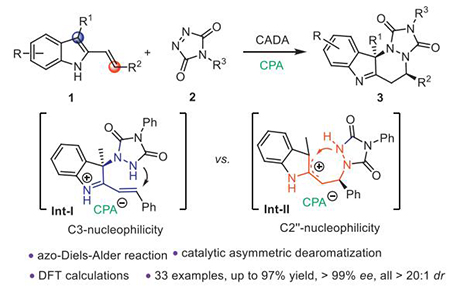
    Due to the high electrophilic nature of azo-dienophiles, azo-Diels-Alder proceeds rapidly even without the need of a catalyst and is therefore regarded as the “click reaction”. This spontaneity causes strong background reaction and poses a daunting challenge to chemists for developing the catalytic asymmetric version. Reported herein is the first catalytic asymmetric dearomative azo-Diels-Alder reaction between 2-vinylindoles and triazoledione. This protocol makes use of the high energy barrier of dearomatization to avert the strong background reaction of azo-Diels-Alder reaction, allowing the implementation of the projected reaction at ambient temperature. Density functional theory calculations have been performed to gain insights into the reaction mechanism and the origins of the enantioselectivity. By using this method, a variety of tetracyclic indole derivatives have been readily prepared in good to excellent yields and with excellent diastereo- and enantio-selectivities (33 examples, up to 97% yield and > 99% ee, > 20:1 dr).
  • Ying-Di Hao, Zhi-Qian Lin, Xiao-Yu Guo, Jiao Liang, Can-Kun Luo, Qian-Tao Wang, Li Guo, Yong Wu
    中国化学快报. 2024, 35(04): 108834. https://doi.org/10.1016/j.cclet.2023.108834
    摘要 ( ) PDF全文 ( ) HTML 可视化 收藏
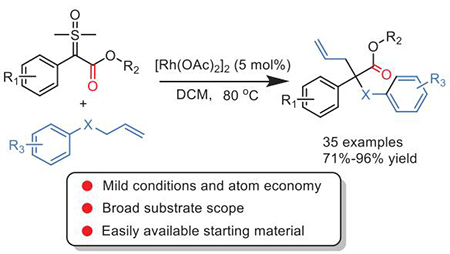
    Doyle-Kirmse rearrangement reactions have received continuous attention as an important method for constructing complex chemical structures. Herein, we disclosed an efficient rhodium-catalyzed Doyle-Kirmse rearrangement reaction, which can simultaneously construct CC bonds and CX (X = S/Se) bonds using sulfoxonium ylides as starting materials to obtain sulfur- or selenium-containing compounds. This strategy is characterized by the safer and greener carbene precursor, high yields and broad substrate scope, possessing a wide range of application.
  • Zhiwei Chen, Heyun Sheng, Xue Li, Menghan Chen, Xin Li, Qiuling Song
    中国化学快报. 2024, 35(04): 108937. https://doi.org/10.1016/j.cclet.2023.108937
    摘要 ( ) PDF全文 ( ) HTML 可视化 收藏
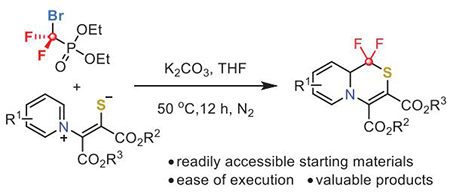
    A practical method for the construction of difluoromethylene-containing 1,4-thiazine moieties using readily available diethyl bromodifluoromethanephosphonate (BrCF2PO(OEt)2) as difluorocarbene precusor has been developed. This transformation features the efficient capture of difluorocarbene by pyridinium 1,4-zwitterionic thiolates. A series of structurally novel and functionalized difluoromethylene-containing 1,4-thiazine derivatives were thus synthesized in good yields.
  • Hui Jin, Qin Cai, Peiwen Liu, Yan Chen, Derong Wang, Weiping Zhu, Yufang Xu, Xuhong Qian
    中国化学快报. 2024, 35(04): 108721. https://doi.org/10.1016/j.cclet.2023.108721
    摘要 ( ) PDF全文 ( ) HTML 可视化 收藏
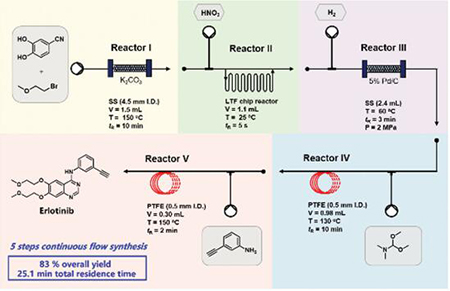
    Erlotinib is an orally administered, highly effective, specific epidermal growth factor receptor tyrosine kinase inhibitor, used to treat non-small cell lung cancer and pancreatic cancer. The traditional synthetic methods for Erlotinib exhibit long reaction time and safety concern. Herein, we describe a novel five-step route for the synthesis of Erlotinib in flow. These five steps comprise etherification, nitration, reduction, addition and cyclization reactions. All steps were optimized and converted to continuous flow process, which drastically reduces the reaction time and considerably improves the process safety as well as the total yield. Enabled by five continuous flow units, Erlotinib is efficiently afforded with an E-factor of 38, an overall yield of 83%, and a total residence time of 25.1 min. Majority steps in this process have been optimized for quantitative conversion, which offers the possibility of telescoping the entire process.
  • Hongxia Li, Xiyang Wang, Du Qiao, Jiahao Li, Weiping Zhu, Honglin Li
    中国化学快报. 2024, 35(04): 108747. https://doi.org/10.1016/j.cclet.2023.108747
    摘要 ( ) PDF全文 ( ) HTML 可视化 收藏
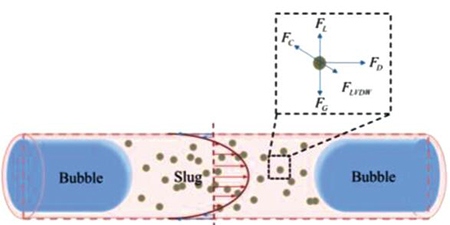
    Using gas-liquid segmented micromixers to prepare nanoparticles that have a homogeneous particle size, controllable shape, and monodispersity advantages. Although nanoparticle aggregation within a microfluid has been shown to be affected by the shear effect, the shear effect triggering conditions in gas-liquid two-phase flow is unclear and the aggregation behavior of nanoparticles under the shear effect is difficult to predict, resulting in uncontrollable physical and chemical properties of nanoparticle aggregates. In this study, a numerical simulation of nanoparticle aggregation in gas-liquid two-phase flow under the shear effect is performed using the CFD-DEM method. Then, the effects of total flow rate, gas-liquid two-phase flow ratio, and particle volume fraction on particle aggregation were analyzed to achieve control of particle aggregation shape and size. Meanwhile, the triggering mechanism of the shear effect and the mechanism of the shear effect on the aggregation of nanoparticles were clarified. The results show that increasing the total flow rate or decreasing the gas-liquid two-phase flow rate ratio can induce the shear effect, which reduces the particle aggregation size and makes the morphology tend to be spherical. Moreover, increasing the particle volume fraction, and total flow rate or decreasing the gas-liquid two-phase flow rate ratio also increases the number of particle collisions and induce interparticle adhesion. Hence, particle adhesion and the shear effect compete with each other and together affect particle aggregation.
  • Shiyu Hou, Maolin Sun, Liming Cao, Chaoming Liang, Jiaxin Yang, Xinggui Zhou, Jinxing Ye, Ruihua Cheng
    中国化学快报. 2024, 35(04): 108761. https://doi.org/10.1016/j.cclet.2023.108761
    摘要 ( ) PDF全文 ( ) HTML 可视化 收藏
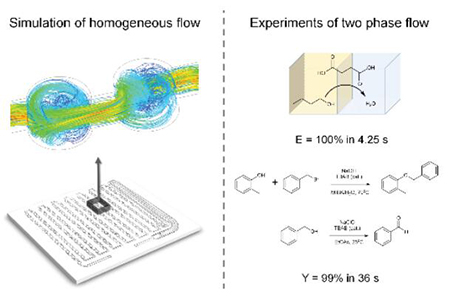
    Microchannels enable the fast and efficient mixing of multiphase fluids. In this study, a millimeter-scale three-dimensional (3D) circular cyclone-type microreactor was designed for the mixing. The flow characteristics and mixing intensity were simulated by computational fluid dynamics simulations at a flow rate range of 12-96 mL/min using a water/ethyl acetate system. In the 3D variable-diameter structure, the microreactor induced paired opposite vortices and abruptly changed the local pressure to achieve a stable turbulent effect within the theoretical range of laminar flow. Tracer injection simulations indicated that sufficient mixing units successfully promote fluid dispersion. Diazo-coupling experiments showed a segregation index of XS = 0. 00,039 within a residence time of 9 s. Extraction experiments on the n-butanol/succinic acid/water system showed that the 3D circular cyclone-type microreactor achieved 100% extraction efficiency (E) in 4.25 s, and the overall volume mass transfer coefficient (KLa) reached 0.05-1.5 s-1 in 12-96 mL/min. The isolated yield of the phase transfer alkylation and oxidation reactions in the 3D circular cyclone-type microreactor achieved 99% within 36 s, which was superior to the coil microreactor and batch reactor.
  • Haoyang Wang, Ronghao Zhang, Yanlun Ren, Li Zhang
    中国化学快报. 2024, 35(04): 108833. https://doi.org/10.1016/j.cclet.2023.108833
    摘要 ( ) PDF全文 ( ) HTML 可视化 收藏
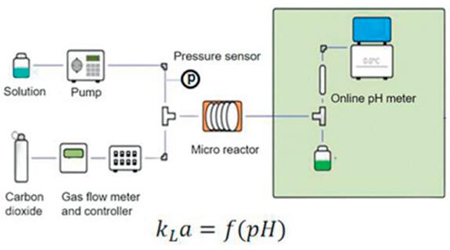
    The research on gas-liquid multiphase reactions using micro reactors is becoming increasingly widespread, given their excellent mass transfer performance. Establishing an accurate and reliable method to measure the gas-liquid mass transfer performance of micro reactors is crucial for evaluating and optimizing the design of micro reactor structure. In this paper, the physical absorption method of aqueous solution-CO2 and the chemical absorption method of sodium carbonate solution-CO2 were proposed. By analyzing the chemical reaction equilibrium during the absorption process, the relationship between the mass transfer of CO2 and the solubility of hydroxide ions in the solution was established, and the total gas-liquid mass transfer coefficient was immediately obtained by measuring the pH value. The corresponding testing platform and process have been established based on the characteristics of the proposed method to ensure fast and accurate measurement. In addition, the chemical absorption method takes into account temperature factors that were not previously considered. The volumetric mass transfer coefficient measured by these two methods is in the same range as those measured by other methods using the same microchannel structure in previous literature. The methods have the advantages of low equipment cost, faster measurement speed, and simpler procedures, which can facilitate its wide application to the evaluation of the mass transfer performance and hence can guide the structure optimization of microchannel reactors.
  • Jun Lu, Jinrui Yan, Yaohao Guo, Junjie Qiu, Shuangliang Zhao, Bo Bao
    中国化学快报. 2024, 35(04): 108876. https://doi.org/10.1016/j.cclet.2023.108876
    摘要 ( ) PDF全文 ( ) HTML 可视化 收藏
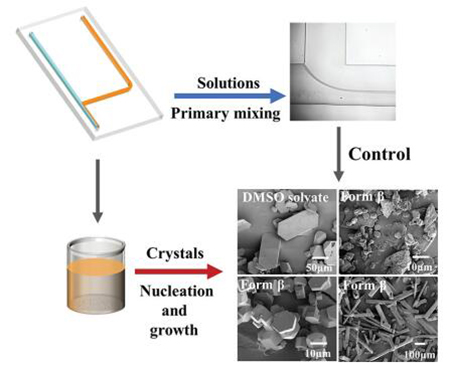
    Crystal habit and crystal form are critical elements in determining product properties and functions. In this work, we developed a microfluidic antisolvent crystallization technique to rapidly screen and accurately control the solid form and crystal habit of triphenylmethanol (Ph3COH). This advanced technique separates the primary mixing of solutions from crystal formation (nucleation and growth) by introducing the microfluidic device, avoiding clogging in microchannels to obtain high-quality crystals. The results show that we can achieve controllable preparation of pure 2Ph3COH·DMSO (DMSO solvate), pure Ph3COH (form β), and mixed crystals with different mass ratios. Moreover, the microscale can prompt the DMSO solvate to grow into hexagonal sheet-like and bulk crystals. We can regulate the aspect ratio of hexagonal sheet-like crystals in binary solvents and control the crystal habit of the form β to transition between long needle-like shapes and short hexagonal prisms in DMF-H2O. Meanwhile, we revealed that the solvent ratio, the antisolvent flow rate, and the initial concentration of Ph3COH are the main factors affecting the solid form selectivity and morphology transition. Such a novel method would be considered as a promising technique to be extended to screen and control key crystallization parameters of other substances.
  • Zhixiang Li, Zhirong Yang, Chang Yao, Bin Wu, Gang Qian, Xuezhi Duan, Xinggui Zhou, Jing Zhang
    中国化学快报. 2024, 35(04): 108893. https://doi.org/10.1016/j.cclet.2023.108893
    摘要 ( ) PDF全文 ( ) HTML 可视化 收藏
    2-Hydroxycarbazole and 4-hydroxycarbazole are important chemicals with extensive applications in optoelectronic materials and pharmaceutical field. State of the art yield of 2-hydroxycarbazole is ~30% and the reaction time is typically in hours or days. Herein, we developed a green route for the continuous and high-throughput synthesis of 2-hydroxycarbazole and 4-hydroxycarbazole via photochemical intramolecular cyclization of 3-hydroxy-2'-chloro-diphenylamine using a self-designed millimeter scale photoreactor, which was designed based on sizing-up and numbering-up strategies for a decent liquid holdup (6.8mL) and fabricated via femtosecond laser engraving technique. The photochemical synthesis was carried out continuously under the illumination of 365nm UV-LED with dimethyl sulfoxide as solvent and potassium t-butoxide as catalyst. It was found that under optimized conditions a 2-hydroxycarbazole yield of 31.6% and a 4-hydroxycarbazole yield of 11.1% were obtained with a residence time of 1min. Compared to semi-batch operations, the reaction time was shortened by 1-2 orders of magnitude. As a result, a throughput of 11.3g/day 2-hydroxycarbazole and 4.0g/day 4-hydroxycarbazole can be achieved from the photoreactor. It was proposed that the short reaction time and high product yield are resulted from higher photon transfer rates and more uniform photon distribution provided by the millimeter scale photoreactor, which enhances the reaction rates and mitigates overreaction.
  • Liliang Chu, Xiaoyan Zhang, Jianing Li, Xuelei Deng, Miao Wu, Ya Cheng, Weiping Zhu, Xuhong Qian, Yunpeng Bai
    中国化学快报. 2024, 35(04): 108896. https://doi.org/10.1016/j.cclet.2023.108896
    摘要 ( ) PDF全文 ( ) HTML 可视化 收藏
    Polysubstituted chiral γ-butyrolactones are the core structural units of many natural products and high value-added flavors and fragrances used in the food and cosmetic industry. Current enzymatic cascade synthesis of these molecules faces the problems of low enzyme activity and phase separation in batch reaction, resulting in low productivity. Herein, we report a new continuous-flow process to synthesize the optically pure Nicotiana tabacum lactone (3S,4S)-4a and whisky lactone (3R,4S)-4b from α,β-unsaturated γ-ketoesters. A new ene reductase (ER) from Swingsia samuiensi (SsER) and a carbonyl reductase (SsCR) were engineered by directed evolution to improve their activity and thermostability. The continuous-flow preparative reactions were performed in two 3D microfluidic reactors, generating (3S,4S)-4a (99% ee and 87% de) and (3R,4S)-4b (99% ee and 98% de) with space-time yields 3 and 7.4 times higher than those of the batch reactions. The significant enhancement in the productivity of enzyme cascade catalysis brought by cutting-edge continuous microfluidic technology will benefit the general multi-enzyme catalytic systems in the future.
  • Chaoqun Ma, Yuebo Wang, Ning Han, Rongzhen Zhang, Hui Liu, Xiaofeng Sun, Lingbao Xing
    中国化学快报. 2024, 35(04): 108632. https://doi.org/10.1016/j.cclet.2023.108632
    摘要 ( ) PDF全文 ( ) HTML 可视化 收藏
    In this work, we designed and synthesized cationic carbon dots (CDs) with a size distribution of 1.6-3.7 nm, which exhibited dark blue fluorescence in the aqueous solution. Based on its excellent luminescence properties, we used it as an energy donor to construct a sequential artificial light-harvesting system (LHS) by employing the energy-matching dyes eosin Y disodium salt (EY) and sulforhodamine 101 (SR101), which could regulate the white light emission (Commission Internationale de l'Eclairage (CIE) coordinate: (0.30, 0.31)) with the energy transfer efficiency (ΦET) of 53.9% and 20.0%. Moreover, a single-step artificial LHS with white light emission (0.32, 0.28) can be constructed directly using CDs and dye solvent 43 (SR) with ΦET and antenna effect (AE) of 48.8% and 6.5, respectively. More importantly, CDs-based artificial LHSs were firstly used in photocatalytic of α-bromoacetophenone, with a yield of 90%. This work not only provides a new strategy for constructing CDs-based LHSs, but also opens up a new application for further applying the energy harvested in CDs-based LHSs to the field of the aqueous solution photocatalysis.
  • Peide Zhu, Yangjia Liu, Yaoyao Tang, Siqi Zhu, Xinyang Liu, Lei Yin, Quan Liu, Zhiqiang Yu, Quan Xu, Dixian Luo, Juncheng Wang
    中国化学快报. 2024, 35(04): 108689. https://doi.org/10.1016/j.cclet.2023.108689
    摘要 ( ) PDF全文 ( ) HTML 可视化 收藏
    Liposomes are one of the significant classes of antitumor nanomaterials and the most successful nanomedicine drugs in clinical translation. However, it is difficult to accurately reveal liposome delivery modes and drug release rates at different pH values to assess the biodistribution and drug delivery pathways in vivo. Here, we established a strategy to integrate Bi-doped carbon quantum dots (CQDs) with liposomes to produce fluorescence visualization and therapeutic effects, namely lipo/Bi-doped CQDs. Lipo/Bi-doped CQDs show good water solubility and physicochemical properties, which can be used for in vitro labeling of colon cancer (CT26) cells and in vivo imaging localization tracking tumors for monitoring. Simultaneously, thanks to the excellent pH sensitivity and ion doping characteristic of Bi-doped CQDs, lipo/Bi-doped CQDs can be used to reveal the drug release rate of liposomes at different pH values and exhibit potential effects in vivo antitumor therapy.
  • Hao Cai, Xiaoyan Wu, Lei Jiang, Feng Yu, Yuxiang Yang, Yan Li, Xian Zhang, Jian Liu, Zijian Li, Hong Bi
    中国化学快报. 2024, 35(04): 108946. https://doi.org/10.1016/j.cclet.2023.108946
    摘要 ( ) PDF全文 ( ) HTML 可视化 收藏
    The reactive oxygen species (ROS) generation efficiency is always limited by the extreme tumor microenvironment (TME), leading to unsatisfactory antitumor effects in photodynamic therapy (PDT). As a promising gas therapy molecule, nitric oxide (NO) is independent of oxygen and could even synergize ROS to enhance the therapeutic effect. However, the short half-life, instability, and uncontrollable release of exogenous NO limited the application of tumor synergistic therapy. Herein, we reported a novel kind of red-emissive carbon dots (CDs) that was capable of lysosome-targeted and light-controlled NO delivery. The CDs were synthesized by using metformin and methylene blue (MB) via a hydrothermal method. The obtained metformin-MB CDs (MMCDs) exhibited a higher 1O2 quantum yield and NO generation efficiency under light emitting diode (LED) light irradiation. Noteworthily, the 1O2 could further in situ oxidize NO into peroxynitrite anions (ONOO-), which own the higher cytotoxicity against cancer cells. Cell experiments indicate that MMCDs could destruct lysosome membrane integrity and kill almost 80% of HepG2 cells under light irradiation while very low cytotoxicity in the dark. Moreover, MMCDs significantly decreased tumor volume and weight after phototherapy in hepatoma HepG2-bearing mice. Our study provides a new strategy for light-controlled NO generation as well as precise lysosome-targeting for enhancement of PDT efficiency.
  • Tiantian Li, Ruochen Jin, Bin Wu, Dongming Lan, Yunjian Ma, Yonghua Wang
    中国化学快报. 2024, 35(04): 108701. https://doi.org/10.1016/j.cclet.2023.108701
    摘要 ( ) PDF全文 ( ) HTML 可视化 收藏
    Unspecific peroxygenases (UPOs, EC 1.11.2.1) is a kind of thioheme enzyme capable of catalyzing various oxidations of inert CH bonds using H2O2 as an oxygen donor without cofactors. However, the enhancement of the H2O2 tolerance of UPOs is always challenging. In this study, the A161C mutant of rDcaUPO, which originates from Daldinia caldariorum, was found to be highly H2O2-resistant. Compared with the wild type, the mutant rDcaUPO-A161C showed a 10-h prolonged half-life and a 64% improved enzyme activity when incubated in 10mmol/L H2O2. The crystal structure analysis at 1.47Å showed that rDcaUPO-A161C exhibited 10 α-helixes (cyan) and a series of ordered rings, forming a single asymmetric spherical structure. The two conserved domains near heme formed an active site with the catalytic PCP and EHD regions (Glu86, His87, Asp88 residues). The H2O2 tolerance of rDcaUPO-A161C was preliminarily explored by comparing its structure with the wild type. Notably, rDcaUPO-A161C showed significantly higher catalytic efficiency than the wild type for the production of hydroxyl fatty acids. This study is anticipated to provide an insight into the structure-function relationship and expand potential applications of UPOs.
  • Min Chen, Boyu Peng, Xuyun Guo, Ye Zhu, Hanying Li
    中国化学快报. 2024, 35(04): 109051. https://doi.org/10.1016/j.cclet.2023.109051
    摘要 ( ) PDF全文 ( ) HTML 可视化 收藏
    Organic semiconductor single crystals (OSSCs) have shown their promising potential in high-performance organic field-effect transistors (OFETs). The interfacial dielectric layers are critical in these OFETs as they not only govern the key semiconductor/dielectric interface quality but also determine the growth of OSSCs by their wetting properties. However, reported interfacial dielectric layers either need rigorous preparation processes, rely on certain surface chemistry reactions, or exhibit poor solvent resistance, which limits their applications in low-cost, large-area, monolithic fabrication of OSSC-based OFETs. In this work, polyethylene (PE) thin films and lamellar single crystals are utilized as the interfacial dielectric layers, providing solvent resistive but wettable surfaces that facilitate the crystallization of 6,13-bis(tri-isopropylsilylethynyl)pentacene (TIPS-PEN) and 6,13-bis(triisopropylsilylethynyl)-5,7,12,14-tetraazapentacene (TIPS-TAP). As evidenced by the presence of ambipolar behavior in TIPS-PEN single crystals and the high electron mobility (2.3 ±0.34cm2V-1s-1) in TIPS-TAP single crystals, a general improvement on electron transport with PE interfacial dielectric layers is revealed, which likely associates with the chemically inertness of the saturated C-H bonds. With the advantages in both processing and device operation, the PE interfacial dielectric layer potentially offers a monolithic way for the enhancement of electron transport in solution-processed OSSC-based OFETs.
  • Wenxiang Ma, Xinyu He, Tianyi Chen, De-Li Ma, Hongzheng Chen, Chang-Zhi Li
    中国化学快报. 2024, 35(04): 109099. https://doi.org/10.1016/j.cclet.2023.109099
    摘要 ( ) PDF全文 ( ) HTML 可视化 收藏
    Developing narrow-bandgap organic semiconductors is important to facilitate the advancement of organic photovoltaics (OPVs). Herein, two near-infrared non-fused ring acceptors (NIR NFRAs), PTBFTT-F and PTBFTT-Cl have been developed with A-πA-πD-D-πD-πA-A non-fused structures. It is revealed that the introduction of electron deficient π-bridge (πA) and multiple intramolecular noncovalent interactions effectively retained the structural planarity and intramolecular charge transfer of NFRAs, extending strong NIR photon absorption up to 950 nm. Further, the chlorinated acceptor, with the enlarged π-surface compared to the fluorinated counterpart, promoted not only molecular stacking in solid, but also the desirable photochemical stability in ambient, which are helpful to thereby improve the exciton and charge dynamics for the corresponding OPVs. Overall, this work provides valuable insights into the design of NIR organic semiconductors.
  • Xiangan Song, Shaogang Shen, Mengyao Lu, Ying Wang, Yong Zhang
    中国化学快报. 2024, 35(04): 109118. https://doi.org/10.1016/j.cclet.2023.109118
    摘要 ( ) PDF全文 ( ) HTML 可视化 收藏
    Single-emitter white organic light-emitting diode (WOLED) based on small organic molecule exhibits great potential in simplifying fabrication process of WOLEDs. However, the design and synthesis of molecule for highly efficient single-emitter WOLED still remains a challenge. Herein, two asymmetric donor-acceptor-acceptor’ (D-A-A’) type molecule (PTZ-PQ-F and PTZ-PQ-CF3) are developed by employing trifluoromethyl (CF3) or fluorine atom as secondary acceptor, which can exhibit white lighting with dual emission bands consisting of blue traditional fluorescence from quasi-axial (ax) conformer and orange thermally activated delayed fluorescence (TADF) from quasi-equatorial (eq) conformer. The introduction of CF3 into PTZ-PQ-CF3 greatly enhanced the photoluminescence quantum yield (PLQY) by suppressing the nonradiative deactivation. Owing to electron-inductive-effect of CF3, the “eq” conformer of PTZ-PQ-CF3 exhibits a much smaller ΔEST of 0.01eV to realize more efficient reverse intersystem crossing (RISC) process, and then enhance the exciton utilization (nearly 100%) of the whole dual emission system. Consequently, single-emitter WOLEDs based on PTZ-PQ-CF3 show nearly standard white emission with EQE of 13.0% and CIE of (0.35, 0.36) in mCP host and show warm white emission with high EQE of 25.5% and CIE of (0.40, 0.47) in 35 DczPPy host, which are the best performance among reported single-emitter WOLEDs.
  • Tingting Huang, Zhuanlong Ding, Hao Liu, Ping-An Chen, Longfeng Zhao, Yuanyuan Hu, Yifan Yao, Kun Yang, Zebing Zeng
    中国化学快报. 2024, 35(04): 109117. https://doi.org/10.1016/j.cclet.2023.109117
    摘要 ( ) PDF全文 ( ) HTML 可视化 收藏
    While heteroatom doping serves as a powerful strategy for devising novel polycyclic aromatic hydrocarbons (PAHs), the further fine-tuning of optoelectronic properties via the precisely altering of doping patterns remains a challenge. Herein, by changing the doping positions of heteroatoms in a diindenopyrene skeleton, we report two isomeric boron, sulfur-embedded PAHs, named Anti-B2S2 and Syn-B2S2, as electron transporting semiconductors. Detailed structure-property relationship studies revealed that the varied heteroatom positions not only change their physicochemical properties, but also largely affect their solid-state packing modes and Lewis base-triggered photophysical responses. With their low-lying frontier molecular orbital levels, n-type characteristics with electron mobilities up to 1.5×10⁻³ cm2 V-1 s-1 were achieved in solution-processed organic field-effect transistors. Our work revealed the critical role of controlling heteroatom doping patterns for designing advanced PAHs.
  • Yikun Wang, Qiaomei Chen, Shijie Liang, Dongdong Xia, Chaowei Zhao, Christopher R. McNeill, Weiwei Li
    中国化学快报. 2024, 35(04): 109164. https://doi.org/10.1016/j.cclet.2023.109164
    摘要 ( ) PDF全文 ( ) HTML 可视化 收藏
    The photovoltaic properties of double-cable conjugated polymers are significantly influenced by the length of the alkyl linkers that connect donor backbones and acceptor side units. In this study, a series of 2-(3-oxo-2,3-dihydroinden-1-ylidene)malononitrile (IC)-based double-cable polymers with alkyl linkers ranging from C8H16 to C16H32 (Px, x = 8, 10, 12, 14, 16) were synthesized for single-component organic solar cells (SCOSCs). Among these, the linker length x = 12 (P12) is found to optimize the power conversion efficiencies (PCEs) in SCOSCs. Specifically, PCEs increase from P8 to P12 and then decline from P12 to P16. Detailed investigations of optical absorption, charge transport, and morphology provide insights into the underlying factors contributing to these PCE variations. The findings indicate that the exceptional photovoltaic properties observed in P12 can be attributed to three key factors: A delicate balance between enhanced charge separation facilitated by the increased spacer length and reduced crystallinity resulting from longer spacers, higher charge mobilities, and well-balanced hole/electron transport characteristics. This study highlights the critical role of linker length in determining the photovoltaic properties of double-cable conjugated polymer-based SCOSCs and offers valuable guidance for the design of novel double-cable conjugated polymers.
  • Jie Wu, Xiaoqing Yu, Guoxing Li, Su Chen
    中国化学快报. 2024, 35(04): 109234. https://doi.org/10.1016/j.cclet.2023.109234
    摘要 ( ) PDF全文 ( ) HTML 可视化 收藏
    Particle engineering has opened the floodgates to material science in both fundamental and application field. However, covalent interactions have not yet been adequately designed in the particle engineering for functional colloidal photonic crystals (CPCs). Herein, we achieved covalent coupling between carboxyl-rich poly(styrene-acrylic acid) (P(St-AA)) monodispersed colloidal particles and amine-rich carbon dots (CDs) based on an feasible and universal particle engineering strategy. The designed CDs-grafted P(St-AA) monodispersed colloidal particles initiate a hydrogen bond-driven assembly mode and ensure the construction of large-scale crack-free CPCs. Moreover, the CDs equipped with selective broad-band absorption capacity could improve the saturation of structural colors for high-visibility CPCs. Furthermore, an injectable photonic hydrogel (IPH) is developed to design CPC supraball hydrogel via integrating the CDs-grafted P(St-AA) CPC supraballs with supramolecular hydrogel. Combining superior flexibility, sufficient self-healing capacity of supramolecular hydrogel with visual optical information of our CPC supraballs, a cyclically reversible coding and decoding system was developed. Meanwhile, we firstly demonstrated the novel strategy of 3D supraballs-based passive cooling. The designed 3D CPC supraball hydrogel presents nearly full observation angle reflections behavior and excellent water evaporation capacity and achieves 3.6 ℃ temperature drops, showing the application advantages in 3D thermal management. This work not only provides a new insight for manipulating optical properties of CPCs, but also demonstrates an easy-to-perform platform, as well as indicates the direction for the promising application of CPCs.
  • Jing Chen, Peisi Xie, Pengfei Wu, Yu He, Zian Lin, Zongwei Cai
    中国化学快报. 2024, 35(04): 108895. https://doi.org/10.1016/j.cclet.2023.108895
    摘要 ( ) PDF全文 ( ) HTML 可视化 收藏
    Cancer cell spheroids (CCS) are a valuable three-dimensional cell model in cancer studies because they could replicate numerous characteristics of solid tumors. Increasing researches have used matrix-assisted laser desorption/ionization mass spectrometry imaging (MALDI-MSI) to investigate the spatial distribution of endogenous compounds (e.g., lipids) in CCS. However, only limited lipid species can be detected owing to a low ion yield by using MALDI. Besides, it is still challenging to fully characterize the structural diversity of lipids due to the existence of isomeric/isobaric species. Here, we carried out the initial application of MALDI coupled with laser-postionization (MALDI-2) and trapped ion mobility spectrometry (TIMS) imaging in HCT116 colon CCS to address these challenges. We demonstrated that MALDI-2 is capable of detecting more number and classes of lipids in HCT116 colon CCS with higher signal intensities than MALDI. TIMS could successfully separate numerous isobaric/isomeric species of lipids in CCS. Interestingly, we found that some isomeric/isobaric species have totally different spatial distributions in colon CCS. Further MS/MS imaging analysis was employed to determine the compositions of fatty acid chains for isomeric species by examining disparities in signal intensities and spatial distributions of product ions. This work stresses the robust ability of TIMS and MALDI-2 imaging in analyzing endogenous lipids in CCS, which could potentially become powerful tools for future cancer studies.
  • Fei Yin, Erli Yang, Xue Ge, Qian Sun, Fan Mo, Guoqiu Wu, Yanfei Shen
    中国化学快报. 2024, 35(04): 108753. https://doi.org/10.1016/j.cclet.2023.108753
    摘要 ( ) PDF全文 ( ) HTML 可视化 收藏
    Developing accurate and sensitive DNA methyltransferase (MTase) analysis methods is essential for early clinical diagnosis and development of antimicrobial drug targets. In this work, by coupling WO3- dots-encapsulated metal-organic frameworks (MOFs) as co-reactants and terminal deoxynucleotidyl transferase (TdT)-mediated template-free branched polymerization, a dual signal-amplified electrochemiluminescent (ECL) biosensor was constructed to detect DNA adenine methylation (Dam) MTase. The employment of WO3- dots-encapsulated MOFs (i.e., NH2-UIO66@WO3-) was not only beneficial for biomolecule conjugation because of the abundant amino groups but also led to a 7-fold enhanced ECL response due to the increased loading of WO3-. Moreover, TdT-mediated template-free branched polymerization promoted the capture of ECL emitters on the electrode surface, achieving 20-fold enhanced signal amplification. The presented ECL biosensor demonstrated a low detection limit of 2.4×10⁻⁴U/mL, and displayed high reliability for the detection of Dam MTase in both spiked human serum and E. coli cell samples, and for the screening of potential inhibitors. This study opens a new avenue for designing a dual signal amplification-based ECL bioassay for Dam MTase and screening inhibitors in the fields of clinical diagnosis and drug development.
  • Lijia Xu, Tong Zhong, Wei Zhao, Bing Yao, Lin Ding, Huangxian Ju
    中国化学快报. 2024, 35(04): 108760. https://doi.org/10.1016/j.cclet.2023.108760
    摘要 ( ) PDF全文 ( ) HTML 可视化 收藏
    Spermatogenesis, maturation, capacitation and fertilization are precisely regulated by glycosylation. However, the relationship between altered glycosylation patterns and the onset and development of reproductive disorders is unclear, mainly limited by the lack of in situ imaging techniques for spermatozoa glycosylation. We developed an efficient and highly specific spermatozoa glycan imaging technique based on the robust chemoselective labeling of sialic acid (Sia) and N-acetyl-d-galactosamine (Gal/GalNAc). We further proposed a “tandem glycan chemoselective labeling” strategy to achieve simultaneous imaging of two types of glycans on spermatozoa. We applied the developed method to the spermatozoa from oligozoospermic patients and diabetic mice and found that these spermatozoa showed higher levels of Sia and Gal/GalNAc expression than the normal groups. Moreover, spermatozoa from diabetic mice showed a severe decrease in number, viability, and forward motility, suggesting that in vivo glucose metabolism disorders may lead to an elevated level of spermatozoa glycosylation and have a correlation with the development of oligoasthenotspermia. Our work provides a research tool to reveal the relationship between glycosylation modification and spermatozoa quality, and a promising clue for the development of glycan-based reproductive markers.
  • Qiongqiong Wan, Yanan Xiao, Guifang Feng, Xin Dong, Wenjing Nie, Ming Gao, Qingtao Meng, Suming Chen
    中国化学快报. 2024, 35(04): 108775. https://doi.org/10.1016/j.cclet.2023.108775
    摘要 ( ) PDF全文 ( ) HTML 可视化 收藏
    There is a close relationship between the biological functions of lipids and their structures, and various isomers greatly increases the complexity of lipid structures. The C=C bond location and sn-position are two of the essential attributes that determine the structures of unsaturated lipids. However, simultaneous identification of both attributes remains challenging. Here, we develop a visible-light-activated aziridination reaction system, which enables the dual-resolving of the C=C bond location and sn-position isomerism of in lipids when combines with liquid chromatography-mass spectrometry (LC-MS). Based on the derivatization of C=C bonds with PhI=NTs, their location in lipids could be easily identified by tandem MS. Especially, the sn-position isomers of unsaturated phosphatidylcholine (PC) can be separated and quantified by LC-MS after the derivatization. By using the proposed method, the significant changes of the sn-position isomers ratios of PC in mouse brain ischemia were revealed. This study offers a powerful tool for deep lipid structural biology.
  • Wangyan Hu, Ke Li, Xiangnan Dou, Ning Li, Xiayan Wang
    中国化学快报. 2024, 35(04): 108806. https://doi.org/10.1016/j.cclet.2023.108806
    摘要 ( ) PDF全文 ( ) HTML 可视化 收藏
    Modern chromatography is increasingly focused on miniaturization and integration. Compared to conventional liquid chromatography, microfluidic chip liquid chromatography (microchip-LC) has the potential due to its zero-dead volume connection and ease of integration. Nano-sized packings have the potential to significantly enhance separation performance in microchip-LC. However, their application has been hindered by packing difficulties. This study presents a method for packing nano-sized silica particles into a microchannel as the stationary phase. The microchip-LC packed column was prepared by combining the weir and the porous silica single-particle as frit to retain the packing particles. A surface tension-based single-particle picking technique was established to insert porous single-particle frit into glass microchannels. Additionally, we developed a slurry packing method that utilizes air pressure to inject nano-sized packing into the microchannel. Pressure-driven chromatographic separation was performed using this nano-packed column integrated into a glass microchip. The mixture of four PAHs was successfully separated within just 8 min using a 5 mm separation channel length, achieving high theoretical plates (106 plates/m). Overall, these findings demonstrate the potential of utilizing nano-sized packings for enhancing chromatographic performance in microchip systems.
  • Cheng Guo, Xiaoxiao Zhang, Xiujuan Hong, Yiqiu Hu, Lingna Mao, Kezhi Jiang
    中国化学快报. 2024, 35(04): 108867. https://doi.org/10.1016/j.cclet.2023.108867
    摘要 ( ) PDF全文 ( ) HTML 可视化 收藏
    RNA modifications have been involved in numerous biological processes, and aberrations of these modifications are tightly associated with various diseases including cancer. Herein, we developed graphene-based solid-phase extraction and robust ultra performance liquid chromatography-tandem mass spectrometry (UPLC-MS/MS) combined with stable isotope-dilution for simultaneous enrichment and accurate determination of 17 modified nucleosides in human urine. We found graphene could effectively adsorb various modified nucleosides in human urine samples. With this method, we identified and quantified these modified nucleosides in urine samples collected from lung cancer patients and healthy controls. We revealed that the levels of 12 modified nucleosides were all diminished in urine from lung cancer patients, compared with healthy controls. It is worth noting that we demonstrated, for the first time, the presence of 5,2'-O-dimethyluridine (m5Um) in human urine. Together, we established a robust analytical method for simultaneous determinations of 17 modified nucleosides in human urine, and our results revealed a close correlation between the concentrations of urinary modified nucleosides and the occurrence of lung cancer, implying the potential applications of these modified nucleosides as noninvasive biomarkers for the early detection of lung cancer. Moreover, this study will stimulate future investigations on the regulatory roles of RNA modifications in the initiation and progression of lung cancer.
  • Jun-Ming Cao, Kai-Yang Zhang, Jia-Lin Yang, Zhen-Yi Gu, Xing-Long Wu
    中国化学快报. 2024, 35(04): 109304. https://doi.org/10.1016/j.cclet.2023.109304
    摘要 ( ) PDF全文 ( ) HTML 可视化 收藏
    Sodium-ion batteries (SIBs) and potassium-ion batteries (PIBs) are the most promising alternatives to lithium-ion batteries, and thus have drawn intensive research attention. Porous carbon materials from different precursors have been widely used as anode materials owing to their compatible storage effectiveness of both larger radii sodium and potassium ions. However, the differential bonding behaviors of Na and K ions with porous carbon-based anode are the significant one worth investigating, which could provide a clean picture of alkali ions storage mechanism. Therefore, in this work, we prepare a porous carbon network derived from sawdust (SDC) wastes, to further analyze the differences on sodium and potassium ions storage behaviors in terms of bond-forming process. It is found that, as-prepared SDC anodes could deliver stable sodium and potassium storage capacities, however, there are notable distinctions in terms of electrochemical behaviors and diffusion processes. By virtue of ex-situ XRD and Raman spectroscopy, the phase transition reaction of potassium ions could be well-observed, and the results shows that the multiple intercalated compounds was formed in SDC network during ions insertion, further resulting in slower diffusion kinetics and larger resistance compared to non-bonded process of sodium ions storage. This study provides more insights into the differences between sodium and potassium ions storage, as well as the energy storage mechanism of porous carbon as anodes for secondary batteries.
  • Yan Cheng, Hua-Peng Ruan, Yan Peng, Longhe Li, Zhenqiang Xie, Lang Liu, Shiyong Zhang, Hengyun Ye, Zhao-Bo Hu
    中国化学快报. 2024, 35(04): 108554. https://doi.org/10.1016/j.cclet.2023.108554
    摘要 ( ) PDF全文 ( ) HTML 可视化 收藏
    The application of multifunctional materials in various fields such as electronics and signal processors has attracted massive attention. Herein, a new organic-inorganic hybrid material [Et3NCH2Cl]2[MnBr4] (1) is reported, which contains two organic amines cations and one [MnBr4] tetrahedral ion. Compound 1 has a dielectric anomaly signal at 338 K, which proves its thermodynamic phase transition. The single crystal measurements at 200 K and 380 K show that the phase transition of compound 1 is caused by the thermal vibration of organic amine cations in the lattice. Moreover, compound 1 shows yellow-green luminescence under UV light irradiation. The magnetism measurements indicate that compound 1 shows switchable magnetic properties. This organic-inorganic material is a multifunctional material with dielectric, optical, and magnetic synergetic switchable effects, which expands a new direction for designing multifunctional materials.
  • Yuan Zhang, Shenghao Gong, A. R. Mahammed Shaheer, Rong Cao, Tianfu Liu
    中国化学快报. 2024, 35(04): 108587. https://doi.org/10.1016/j.cclet.2023.108587
    摘要 ( ) PDF全文 ( ) HTML 可视化 收藏
    MOF-based core-shell structures with high surface area, abundant active sites, and broad absorption bands are viable alternatives to traditional single-component photocatalysts. In this report, we describe the design and construction of delicate Ag nanowires@NH2-UiO-66 with a core-shell structure for use as photocatalysts in imine synthesis under light. The optimized composites exhibited 80% imine production, which was higher than both MOF and Ag NWs. The significant improvement in photocatalytic activity under light may be attributed to the plasmonic effect of silver nanowires and their core-shell structure, which promotes the separation of electron-hole pairs. Moreover, the photocatalytic activity of the core-shell nanostructure may provide valuable insight into the design and construction of MOF-based composite photocatalysts for oxidative coupling of amines.
  • Pingping Wang, Huixian Miao, Kechuan Sheng, Bin Wang, Fan Feng, Xuankun Cai, Wei Huang, Dayu Wu
    中国化学快报. 2024, 35(04): 108600. https://doi.org/10.1016/j.cclet.2023.108600
    摘要 ( ) PDF全文 ( ) HTML 可视化 收藏
    The blue-light-excitable phosphors play a crucial role in the high-performance white LEDs. Here, we report on two new Cu(I) coordination network materials as yellow-emitting phosphors prepared by suitably expanded π-conjugated triazole ligands. Upon blue-light irradiation, these complexes exhibit efficient solid-state emission and enhanced photostability. Through incorporating the yellow phosphor and a commercial blue-green powder (BaSi2N2O2:Eu2+) with a blue LED chip, the phosphor-converted LED devices display remarkable white emission properties. The experimental results demonstrate that the Cu(I) coordination network materials function as promising blue-light excitable phosphors with great application potential for full-spectrum white LEDs.
  • Botao Gao, He Qi, Hui Liu, Jun Chen
    中国化学快报. 2024, 35(04): 108598. https://doi.org/10.1016/j.cclet.2023.108598
    摘要 ( ) PDF全文 ( ) HTML 可视化 收藏
    The electric field-induced irreversible domain wall motion results in a ferroelectric (FE) hysteresis. In antiferroelectrics (AFEs), the irreversible phase transition is the main reason for the hysteresis effects, which plays an important role in energy storage performance. Compared to the well-demonstrated FE hysteresis, the structural mechanism of the hysteresis in AFE is not well understood. In this work, the underlying correlation between structure and the hysteresis effect is unveiled in Pb(Zr,Sn,Ti)O3 AFE system by using in-situ electrical biasing synchrotron X-ray diffraction. It is found that the AFE with a canting dipole configuration, which shows a continuous polarization rotation under the electric field, tends to have a small hysteresis effect. It presents a negligible phase transition, a small axis ratio, and electric field-induced lattice changing, small domain switching. All these features together lead to a slim hysteresis loop and a high energy storage efficiency. These results offer a deep insight into the structure-hysteresis relationship of AFEs and are helpful for the design of energy storage material.
  • Yukai Tong, Zhijun Wu, Bo Zhou, Min Hu, Anpei Ye
    中国化学快报. 2024, 35(04): 109062. https://doi.org/10.1016/j.cclet.2023.109062
    摘要 ( ) PDF全文 ( ) HTML 可视化 收藏
    The surface tension of troposphere aerosols can significantly influence their atmospheric processes and key properties, particularly on the morphology, the phase transition, the activation as cloud condensation nuclei, and the gas-particle partitioning. However, directly measuring the surface tension of single ambient aerosol is quite challenging, due to the limitations of their picolitre volumes and thermal motion. Here, we developed a dual laser tweezers Raman spectroscopy (DLT-RS) system to directly sense the surface tension of single airborne microdroplets (PM10 particles). A pair of aerosol droplets were trapped and driven to coalesce by the laser tweezers. Meanwhile, the backscattering light intensity and bright-field images during the coalescence process were recorded to characterize the aerosol surface tension. A remarkable advantage of directly sensing aerosol surface tension is that the solutes in aerosols are often supersaturated, which is common in atmospheric aerosols but almost unavailable in bulk solutions. We experimentally measured the surface tension of aerosols composed of nitrates or oxalic acid/nitrate mixture. Besides, the variation of surface tension during aerosol aging process was also explored, which brings possible implications on the surface evolution of actual ambient aerosol during their atmospheric lifetime.
  • Luyan Shi, Ke Zhu, Yuting Yang, Qinrui Liang, Qimin Peng, Shuqing Zhou, Tayirjan Taylor Isimjan, Xiulin Yang
    中国化学快报. 2024, 35(04): 109222. https://doi.org/10.1016/j.cclet.2023.109222
    摘要 ( ) PDF全文 ( ) HTML 可视化 收藏
    Application of transition metal boride (TMB) catalysts towards hydrolysis of NaBH4 holds great significance to help relieve the energy crisis. Herein, we present a facile and versatile metal-organic framework (MOF) assisted strategy to prepare Co2B-CoPOx with massive boron vacancies by introducing phytic acid (PA) cross-linked Co complexes that are acquired from reaction of PA and ZIF-67 into cobalt boride. The PA etching effectively breaks down the structure of ZIF-67 to create more vacancies, favoring the maximal exposure of active sites and elevation of catalytic activity. Experimental results demonstrate a drastic electronic interaction between Co and the dopant phosphorous (P), thereby the robustly electronegative P induces electron redistribution around the metal species, which facilitates the dissociation of B-H bond and the adsorption of H2O molecules. The vacancy-rich Co2B-CoPOx catalyst exhibits scalable performance, characterized by a high hydrogen generation rate (HGR) of 7716.7mL min-1 g-1 and a low activation energy (Ea) of 44.9kJ/mol, rivaling state-of-the-art catalysts. This work provides valuable insights for the development of advanced catalysts through P doping and boron vacancy engineering and the design of efficient and sustainable energy conversion systems.
  • Wenhao Yan, Shuaiya Xue, Xuerui Zhao, Wei Zhang, Jian Li
    中国化学快报. 2024, 35(04): 109224. https://doi.org/10.1016/j.cclet.2023.109224
    摘要 ( ) PDF全文 ( ) HTML 可视化 收藏
    In an era where the concept of green development is deeply rooted, magnesium (Mg) alloy as a light metal has a long-term development prospect in the process of energy saving, emission reduction and environmental improvement. However, anti-corrosion performance of Mg alloy is poor due to the high chemical activity and low equilibrium potential, which limits the development of Mg alloy products. Herein, three-dimensional mesopore hollow polypyrrole spheres (MHPS) were prepared, and the MHPS was inserted into the middle of the stacked hexagon boron nitride (h-BN) lamellae, which allowed the h-BN to be separated forming a further composite with abundant pore structure. Subsequently, the MHPS/h-BN-OH composite was uniformly sprayed on the Mg alloy surface via simple spraying method to form the superhydrophobic surface (SHS). Finally, the slippery liquid infused porous surface (SLIPS) was successfully fabricated by applying drops of silicone lubricant on the superhydrophobic coating surface. After a series of characterization and testing, the results showed that the stacking of h-BN lamellae was significantly reduced after h-BN was successfully embedded by MHPS. In addition, the fabricated SLIPS have excellent self-cleaning, mechanical stability, anti-icing and anti-corrosion properties. Therefore, the method of embedding polymer microspheres not only offers a new strategy for h-BN exfoliation, but also the successful prepared SLIPS largely retards the corrosion of Mg alloy while providing new ideas for the development of SLIPS.
  • Peng Meng, Qian-Cheng Luo, Aidan Brock, Xiaodong Wang, Mahboobeh Shahbazi, Aaron Micallef, John McMurtrie, Dongchen Qi, Yan-Zhen Zheng, Jingsan Xu
    中国化学快报. 2024, 35(04): 108542. https://doi.org/10.1016/j.cclet.2023.108542
    摘要 ( ) PDF全文 ( ) HTML 可视化 收藏
    Coordination complex of a copper cyanurate (Cu(Ⅱ)-CA) was transformed into coordination polymers upon the stimulus of extra Cu(Ⅱ) through “directed Ostwald ripening”. By increasing the molar ratio of Cu(Ⅱ) to CA, we obtained two coordination polymers with selective coordination sites: Cu(Ⅱ)-κN(HCA)κN-Cu(Ⅱ) and Cu(Ⅱ)-κN(HCA)κO-Cu(Ⅱ), which display disparate magnetic interactions.
  • Tao Ban, Xi-Yang Yu, Hai-Kuo Tian, Zheng-Qing Huang, Chun-Ran Chang
    中国化学快报. 2024, 35(04): 108549. https://doi.org/10.1016/j.cclet.2023.108549
    摘要 ( ) PDF全文 ( ) HTML 可视化 收藏
    One-step conversion of methane and formaldehyde into ethanol is a 100% atom-efficient process for carbon resources utilization and environment protection but still faces eminent challenges due to the lacking of efficient catalysts. Therefore, developing active and stable catalysts is crucial for the co-conversion of methane and formaldehyde. Herein, twelve kinds of “Single-Atom” - “Frustrated Lewis Pair” (SA-FLP) dual-active-site catalysts are designed for the direct conversion of methane and formaldehyde to ethanol based on density functional theory (DFT) calculations and microkinetic simulations. The results show that the SA-FLP dual active sites can simultaneously activate methane at the SA site and activate formaldehyde at the FLP site. Among the twelve designed SA-FLP catalysts, Fe1-FLP shows the best performance in the co-conversion of methane and formaldehyde to ethanol with the rate-determining barrier of 1.15eV. Ethanol is proved as the main product with the turnover frequency of 1.32× 10⁻⁴ s-1 at 573K and 3bar. This work provides a universal strategy to design dual active sites on metal oxide materials and offers new insights into the effective conversion of methane and formaldehyde to desired C2 chemicals.